

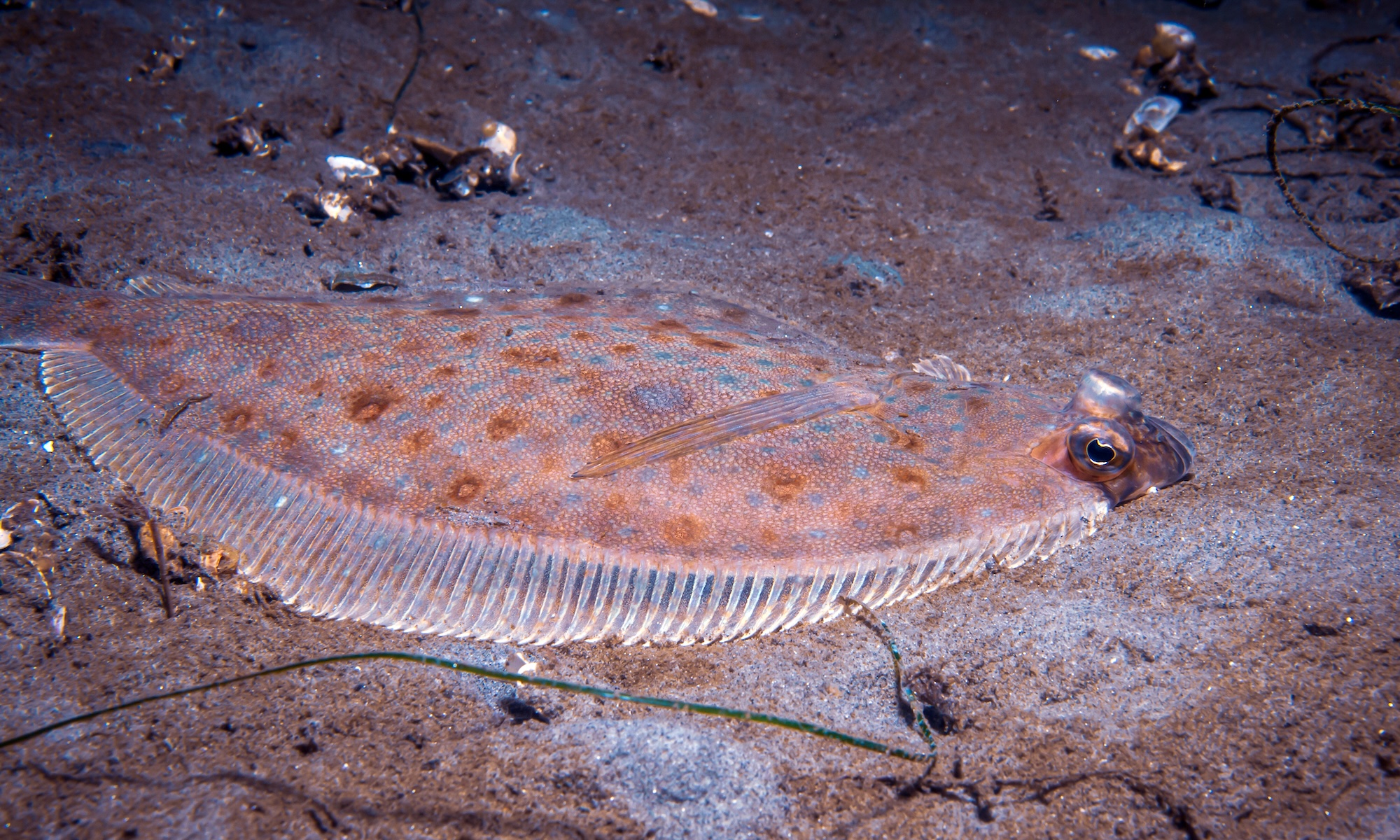
Oxygen is fundamental to almost all life on earth, but not all marine species require the same amount. Some are adapted to live in deeper waters with less oxygen. Others will tend to inhabit more oxygen-rich areas closer to the surface. Some species can move quickly if oxygen levels get low, but others that are more rooted in place may die.
This variation can make understanding the impacts of low dissolved oxygen on species complicated, while posing a problem for regulators concerned about the threat of oxygen-depleting nutrients and algal blooms in Puget Sound.
A new analysis from the Puget Sound Institute and the University of Washington School of Aquatic and Fishery Sciences examines an established approach to assessing oxygen risks at the species level, presenting case studies for English sole, Dungeness crabs, and Chinook salmon. The July 2026 report draws together individual species metabolic rates, complex statistics, and results from the Salish Sea Model, which predicts water quality conditions at any time, location, and water depth throughout Puget Sound.
The three case studies serve as “proof of concept” for how the methodology could provide “additional lines of evidence” to understand the effects of human activities on the species that live in Puget Sound, says Puget Sound Institute scientist and report coauthor Stefano Mazzilli. [The Puget Sound Institute is the publisher of the Encyclopedia of Puget Sound and Salish Sea Currents.]
Effects on habitat
At the center of the inquiry is the degree to which habitat for individual species might be lost as oxygen availability in the water decreases. Factors like water temperature and species metabolic rates will influence what the scientists call “potential aerobic habitat.”
The findings suggest, for example, that Dungeness crabs (Metacarcinus magister) and English sole (Parophrys vetulus) sometimes encounter waters with oxygen scarce enough to hinder basic activities like swimming and feeding in certain parts of Puget Sound. Oxygen levels may occasionally drop too low for Chinook salmon (Oncorhynchus tshawytscha) in some deep areas of their habitat, but at any given location they always have an oxygen-rich refuge higher in the water column.
In the broad sense, such findings will not surprise experts. It’s well known that certain parts of Puget Sound have naturally low oxygen levels, especially the southern part of Hood Canal and various terminal inlets and embayments during late summer and fall, extending into winter in Hood Canal.
It’s also widely accepted that nitrogen in effluent discharged from wastewater treatment plants, washed into rivers from fertilized agricultural fields, and from other human activities may further decrease oxygen levels. But just how significant those issues are has been a subject of debate, especially with regard to the human influence on low-oxygen conditions. How much do anthropogenic nutrient inputs matter for aquatic life? And what should be done about it? That has spurred ongoing questions about how to regulate nutrient discharges from wastewater treatment plants and other sources like agriculture entering the waterway. At stake are billions of dollars in potential costs for treatment plant upgrades balanced with concerns over the fundamental health of the ecosystem.
The new study, funded in part by King County, parses the impact of human nutrient inputs in fine temporal and spatial detail. Unlike other methodologies based on a single oxygen threshold, it accounts for the effects of temperature on oxygen dynamics as well as species-specific differences in oxygen tolerance.
Nutrients from human activities are responsible for a real but relatively small proportion of habitat compression – meaning potential habitat that a species cannot make use of for a given purpose due to low oxygen levels – experienced by all three species, the analysis reveals. According to the study, anthropogenic nutrients were responsible for the loss of no more than about 1% of habitat for each species, even during the worst times of the year.
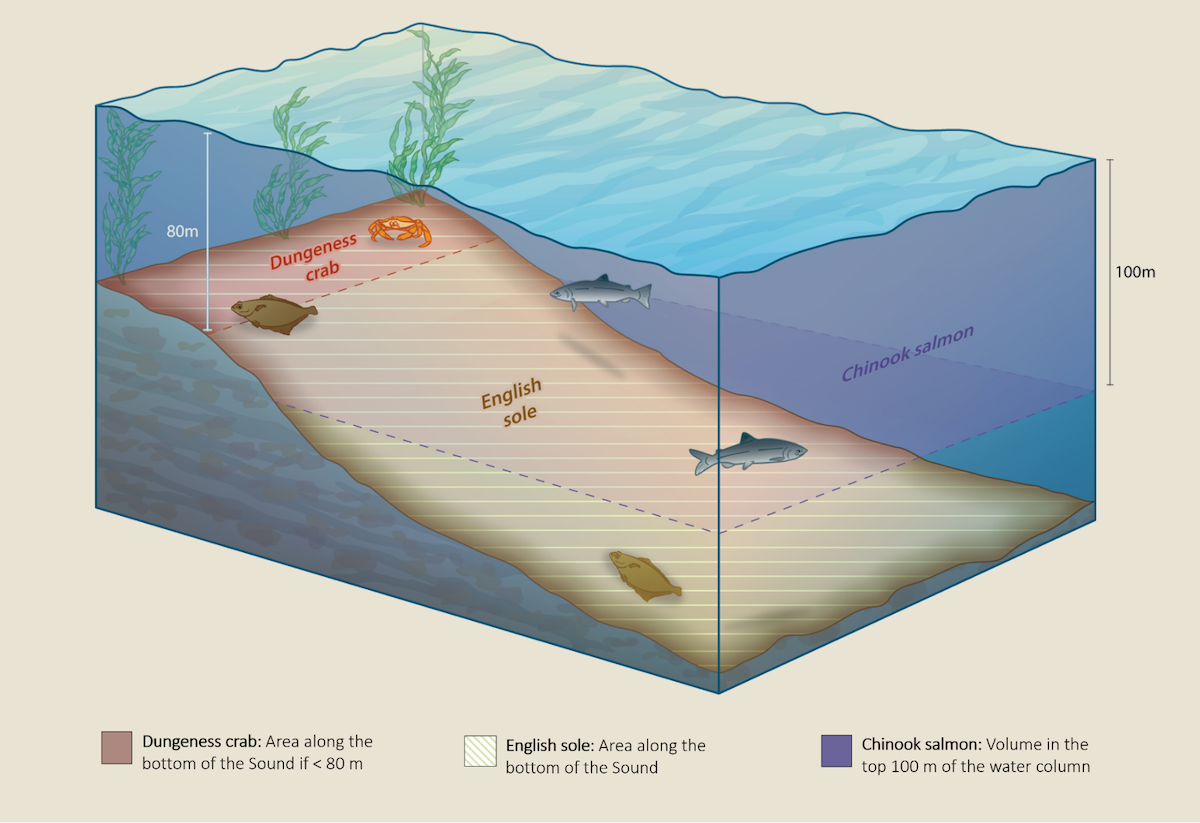
But the three animals each encounter oxygen limitations at slightly different times of year, in different locations, and affecting varying proportions of their potential habitat at different times, pointing to the importance of a place-by-place and species-by-species approach to dissolved oxygen assessment, the researchers say.
Taking the Temperature
This goes a step beyond commonly used thresholds for determining when and where waters are dangerously low in oxygen, a condition known as hypoxia. Scientists typically consider any oxygen levels below 2 mg/L to be hypoxic, but that standard may not apply equally to all species under all conditions.
For example, Chinook salmon consistently require more oxygen across a range of temperatures than the 2 mg/L hypoxia threshold. In contrast, Dungeness crabs have sufficient oxygen below the hypoxia threshold in cold water but not in warmer water.
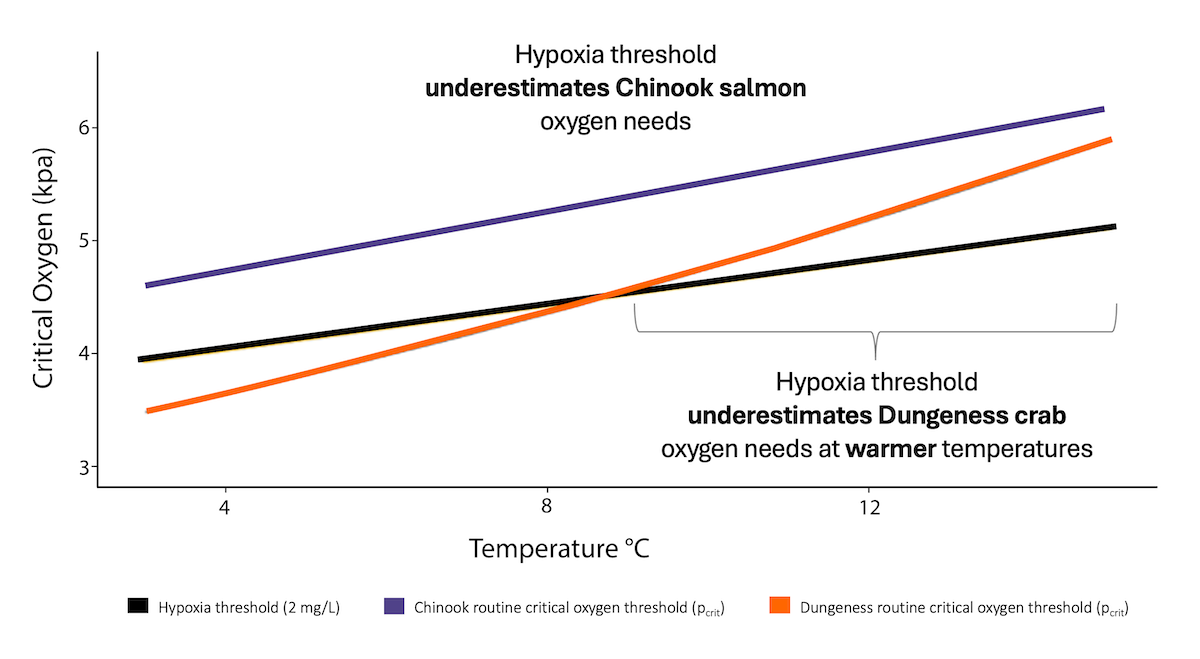
To determine how individual species react to low oxygen, the report authors looked at the metabolic rates of each species, a process that also reveals the consumption of oxygen during routine activities. In the laboratory, scientists have measured the oxygen needs of many aquatic species, which vary with temperature and body size. In this way, a physiological threshold can be determined for a species when the measured oxygen level falls below the level where aerobic metabolism can be maintained.
Key to this relationship is that an organisms’ metabolic needs generally increase with temperature, meaning that they need more oxygen when waters are warmer. Meanwhile, warmer water can also lower available dissolved oxygen while simultaneously increasing how much oxygen species need, placing a further squeeze on aquatic life. “Without temperature, you don’t have the full story,” Mazzilli says.
A metric known as the metabolic index, developed about a decade ago by scientists led by Curtis Deutsch, then at the University of Washington and now at Princeton University, captures the effect of temperature on species’ oxygen needs. The metabolic index is defined as an organism’s oxygen supply relative to its demand and is both temperature-dependent and species-specific.
The metabolic index “has been gaining traction” in the marine physiology community to help explain why different species are found where, says Christina Frieder, a scientist with the Southern California Coastal Water Research Project. The metric is usually “looked at through the lens of climate change” to predict how rising ocean temperatures may constrain habitat for marine species.
Frieder and her colleagues conducted one of the first large-scale modeling studies to use the metabolic index to understand the effect of anthropogenic nutrients, focusing on the Southern California Bight. Frieder’s coauthor, Martha Sutula, presented a preliminary version of the work (PDF), which looked at the northern anchovy (Engraulis mordax), as part of a 2022 PSI series on the science of Puget Sound water quality; the effort helped inspire the new UW report.
In late summer, northern anchovy lose an average of about 25% of their potential habitat in an area of the Bight between 30 and 90 kilometers offshore where nutrient-laden wastewater discharged from Southern California’s metropolitan areas becomes trapped by eddies and exacerbates seasonal deoxygenation, the researchers reported in a 2024 paper.
The Robin Hood effect
The problem is that not all species are as well studied as northern anchovy. “We actually don’t know the oxygen tolerance levels for most of the marine life,” says Tim Essington, a fisheries ecologist at the University of Washington and one of the report’s coauthors.
Enter phylogenetic trait imputation, a statistical method that uses information from better studied species to estimate values for other species that lack good experimental and empirical data, while accounting for how closely related the various species are.
“We’re taking from the data-rich species and giving it to the data-poor species,” says Essington, who led an effort to apply the phylogenetic trait imputation framework to oxygen tolerance. “We’re trying to Robin Hood our information to cover those species where we don’t have the information that we want.”
In a paper published earlier this year, Essington and his collaborators gathered 434 laboratory measurements of oxygen tolerance covering 148 species across six phyla and entered them into a model that can be used to calculate the metabolic index for other species that don’t have data available.
The new UW report leverages and extends that approach. The researchers chose three species as case studies based on their ecological, economic, and cultural importance in Puget Sound, as well as the availability of data. They added a few more studies to Essington’s database (more scientific papers are being published all the time) and estimated critical oxygen levels for the three animals.
Then, they compared these values to outputs from the Salish Sea Model to understand when, where, and how much habitat compression due to low oxygen occurs for each species. They ran the model based on current conditions as well as pre-European settlement to isolate the effects of anthropogenic nutrient inputs from Washington State on deoxygenation.
There are two ways to calculate the metabolic index: the routine metabolic index, based on the threshold below which an organism becomes unable to carry out its usual activities, or the basal metabolic index, based on the threshold below which it dies. The UW report emphasizes the first, more conservative approach.
The researchers also report habitat compression in multiple ways, including the average extent of daily compressed habitat during the months when habitat compression occurs and the maximum extent of compressed habitat on the worst day of the year. “We think that those can complement each other in terms of painting the picture,” says PSI staff member and report coauthor Marielle Kanojia.
Calculating Compression
The locations and times of year pinpointed by the analysis aren’t entirely surprising. Dungeness crab and English sole both face habitat compression in Hood Canal during late summer and fall, and for shorter periods in various other terminal inlets and embayments throughout Puget Sound.
But the details vary somewhat from one species to the next, and from location to location. “The worst day of the year is different region to region” within Puget Sound, Mazzilli says.
For Dungeness crab, average daily habitat compression during the months when compression occurs is 47 km2, or 1.6% of its total potential habitat across Puget Sound. Anthropogenic nitrogen is responsible for the loss of 3.7 km2, or 0.12% of potential habitat, on the average day – about 7.8% of the total.
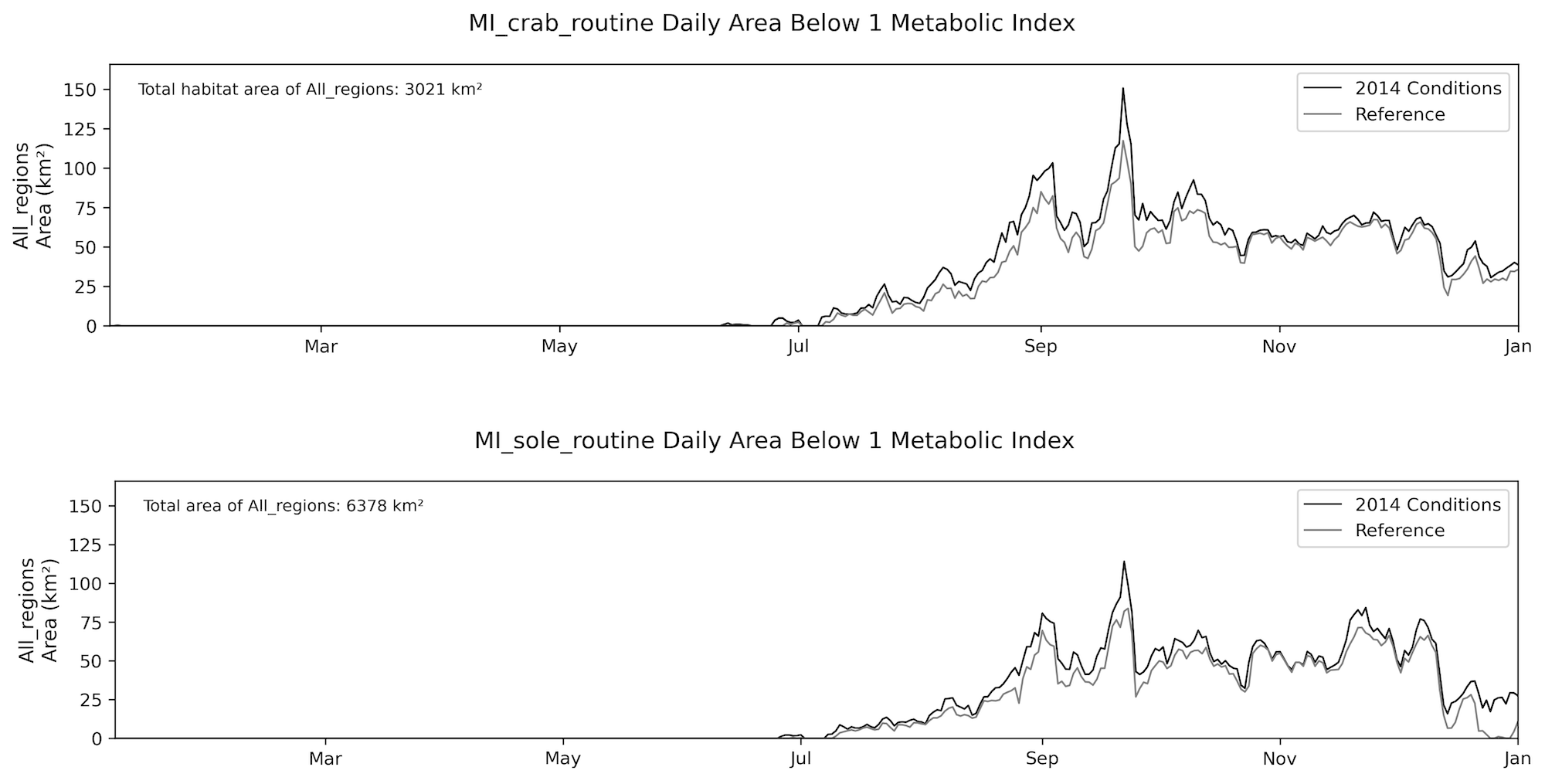
Anthropogenic nitrogen tends to have a greater impact when stress from low-oxygen conditions is at its worst – during late summer when oxygen levels are low and water temperatures are still warm. On the worst day of the year, Dungeness crab loses 5.0% of its habitat region-wide due to deoxygenation, with 1.1% or about one-fifth of the total attributable to nitrogen from human sources.
The Salish Sea Model reports conditions on an hour-by-hour basis, the researchers note. The “worst” conditions reflect the maximum extent of habitat that is below the oxygen threshold for a certain species, but these conditions may not persist for the entire day.
Both Dungeness crab and English sole live on the bottom of Puget Sound. But English sole can live in deeper waters than the crab and are also less sensitive to deoxygenation. So, while English sole habitat compression occurs in similar places and at similar times of year to Dungeness crab, it is smaller in spatial extent and with fewer days affected.
Average daily habitat compression for English sole is 41 km2, or 0.64% of potential habitat during the season of compression, the researchers calculated. On the worst day of the year, English sole loses 114 km2 of its potential habitat to deoxygenation, with 30 km2 attributable to anthropogenic nitrogen, approximately one-quarter of the total loss.
Individual crabs and sole in areas that experience oxygen levels lower than each species’ metabolic index will, by definition, have trouble carrying out basic activities like swimming and feeding. What this means for individual survival and population health is not yet clear, the authors say. Meanwhile, the majority of Puget Sound at any given time – will have oxygen levels sufficient to support the daily activities of these species. But the routine metabolic index does not account for growth and reproduction – which may involve greater oxygen demand.
For Chinook salmon, average habitat compression during the low-oxygen season amounts to 1.3 km3, or 0.29% of potential habitat region wide. On the worst day of the year, salmon lose 0.84% of their total potential habitat due to deoxygenation, with anthropogenic nitrogen responsible for 0.13% -- or about 15% of the total loss.
Of the three species, Chinook salmon require higher oxygen levels than the other species in the study. That might lead some to expect more of their habitat to be impacted. But Chinook salmon are a pelagic species that inhabit the top 100 meters of the water column, and the three-dimensional nature of salmon life means they experience less habitat compression than the two benthic species.
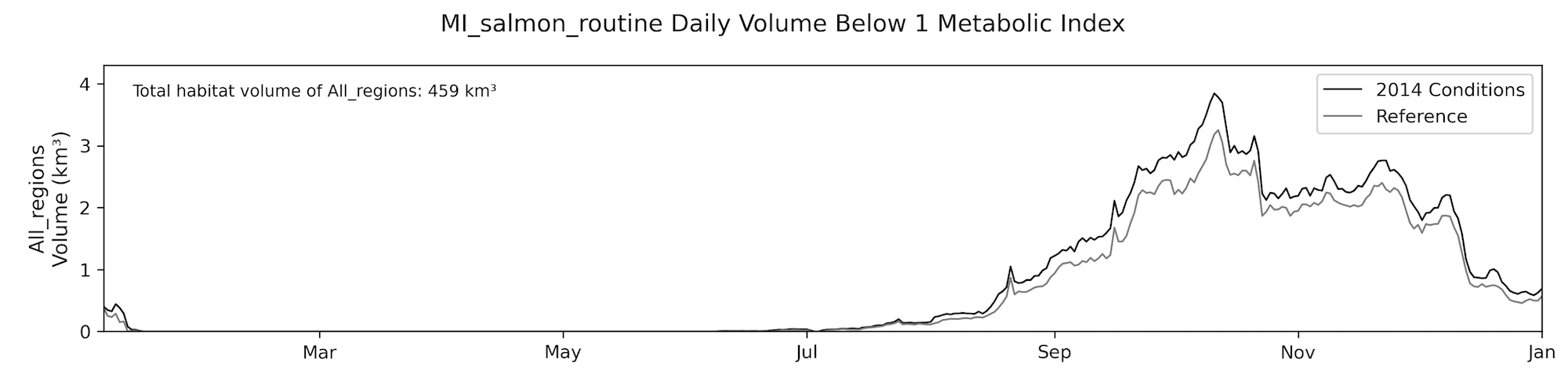
If oxygen is low in deeper parts of Chinook habitat, it is more likely that salmon will be swimming in more oxygen-rich surface waters and will avoid swimming down into more hypoxic waters. For this reason, the researchers calculated Chinook salmon habitat compression by volume rather than by area – in keeping with the project’s overall ethos of focusing on what’s most relevant for individual species as they go about their lives in the natural environment. However, more research is necessary to understand the consequences of moving to access oxygenated “refuge” waters.
Although habitat compression only affects a small percentage of habitat for each of the three species region-wide, the effects in local areas can be more substantial: in Hood Canal, Chinook salmon lose 18% of their habitat volume and Dungeness crab lose 35% of their potential habitat area on the worst day of the year, which occurs in October for Chinook salmon and in September for Dungeness crab in that location, according to the model. (The worst day for a species in a particular area may be different from its worst day in the Puget Sound region as a whole.) Nutrients from human activities lead to a loss of 2.4% and 2.3% of potential habitat in Hood Canal for those species on those dates, respectively.
The researchers also produced time series showing the day-by-day extent of habitat compression, helping to visualize where and when deoxygenation is a problem for each species.
In the future, the approach could be used to assess the impact of multiple human-caused stressors at the same time. PSI researchers next plan to model how increases in water temperature expected with climate change will affect habitat compression in the coming decades.
Many other questions remain, including how oxygen tolerance varies at different life stages, how moving to avoid low-oxygen conditions might expose animals to predation or reshuffle food webs, and how best to convey the uncertainty associated with metabolic index calculations.
“Lots of details to be filled in,” Essington says. “But the core framework looks really, really promising.”
This article was funded in part by King County in conjunction with a series of online workshops exploring Puget Sound water quality. Its content does not necessarily represent the views of King County or its employees.