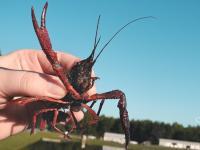
Species: Procambarus clarkii

Red Swamp Crawfish
Species
    Procambarus clarkii

    4th pereiopods; male first pleopod terminating in 4 elements, cephalic process strongly lobate and with sharp angle on caudodistal margin, lacking subapical setae, with strong angular shoulder on cephalic margin quite proximal to terminal elements, that of right pleopod wrapped around margin to appear reduced or absent (Hobbs, 1976). [LENGTH: to 60 TCL; to 125 TL] [WIDTH: to 25 mm]

    Source: Encyclopedia of Life

    Kingdom
    Animalia
    Phylum
    Crustacea
    Class

    Malacostraca

    Order

    Decapoda

    Family

    Cambaridae

    Genus

    Procambarus

    Classification
    Other Global Common Names
    Louisiana Red - Red Crawfish
    Informal Taxonomy
    Animals, Invertebrates - Crustaceans - Crayfishes
    Formal Taxonomy
    Animalia - Crustacea - Malacostraca - Decapoda - Cambaridae - Procambarus - (Busack, 1989).

    4th pereiopods; male first pleopod terminating in 4 elements, cephalic process strongly lobate and with sharp angle on caudodistal margin, lacking subapical setae, with strong angular shoulder on cephalic margin quite proximal to terminal elements, that of right pleopod wrapped around margin to appear reduced or absent (Hobbs, 1976). [LENGTH: to 60 TCL; to 125 TL] [WIDTH: to 25 mm]

    Source: Encyclopedia of Life

    Habitat Type Description
    Freshwater
    Migration
    false - false - false - Reports of migrations of males of several miles over comparatively dry areas, esp. in fall rainy season.
    Non-migrant
    false
    Locally Migrant
    false
    Food Comments
    Opportunistic; thrives on various commercial "pet foods".
    Reproduction Comments
    Year round breeder, intrapopulational variation of seasonality high & single female may produce >1 brood in a year.
    NatureServe Global Status Rank
    G5
    Global Status Last Reviewed
    2009-07-01
    Global Status Last Changed
    1996-02-19
    Other Status

    Currently Stable - 1996-01-01

    Conservation Status Map
    <img src="http://www.natureserve.org/explorer/servlet/GetMapGif?US.AL=SNR&US.AZ=SE&US.AR=SNR&US.CA=SE&US.FL=S3&US.GA=SE&US.HI=SE&US.ID=SE&US.IL=S4&US.IN=SNR&US.KY=SU&US.LA=S5&US.MD=SE&US.MA=SNR&US.MS=SNR&US.MO=SNR&US.NV=SE&US.NM=SE&US.NY=SE&US.NC=SE&US.OH=SE&US.OK=S3&US.OR=SE&US.PA=SE&US.RI=SE&US.SC=SE&US.TN=S5&US.TX=SNR&US.UT=__&US.VA=SE&US.WA=SE&US.WY=SNR" alt="Conservation Status Map" style="width: 475px; height: auto;" />
    Global Range
    G - 200,000-2,500,000 square km (about 80,000-1,000,000 square miles) - G - Native range extends from the Mississippi-Ohio confluence down the Mississippi River floodplain to Louisiana, and along the Gulf coastal Plain southwest to Alabama, to the Rio Grande basin in south New Mexico and north Mexico. Mexican distribution includes Baja California, Baja California Sur, Chihuahua, Sonora, Sinaloa, Durango, Coahuila, Nuevo Leon, and Tamaulipas (Hernandez et al., 2008). It was widely introduced in many places throughout Africa, Asia, and Europe, and also outside its native range in North America. (See Hobbs, 1989). Genetic variation in introduced European populations found to be high enough to uniquely fingerprint most of the surveyed individuals (Barbaresi et al., 2003) and a similar situation exists in Asia (Yue et al., 2010). In the United States, established non-native populations now occur in California, Nevada, Idaho, Illinois, New York, North Carolina, Ohio, Oregon, and Washington (Taylor and Schuster, 2004).
    Global Range Code
    G
    Global Range Description
    200,000-2,500,000 square km (about 80,000-1,000,000 square miles)
    ELEMENT_GLOBAL.2.117840