Geography

We use geography to locate, organize, and describe places on the earth. This site focuses on the Puget Sound and broader Salish Sea regions of Washington state and British Columbia, which may be spatially mapped and subdivided using a variety of physical, political, or human factors.  The information on this site is generally limited to the Salish Sea waters and the surrounding land basin draining into those waters.

Overview

The boundaries of Puget Sound and the Salish Sea are not always consistently defined by scientists and government agencies. This article clarifies the distinctions between oceanographic and watershed-based definitions of these geographic areas. 

Water Resource Inventory Areas (WRIA). Map: Kris Symer. Data source: WAECY.

Related Articles

The Puget Sound Fact Book brings together statistics and other information about the health and makeup of the Puget Sound ecosystem. Areas of focus include climate change, geography, water quality, habitats, human dimensions and regional species. The fact book was prepared for the Encyclopedia of Puget Sound with funding from the Environmental Protection Agency and the Puget Sound Partnership.

Puget Sound is the second largest estuary in the contiguous United States. Today, we understand that estuaries — where freshwater and saltwater merge — are among the most productive places for life to exist.

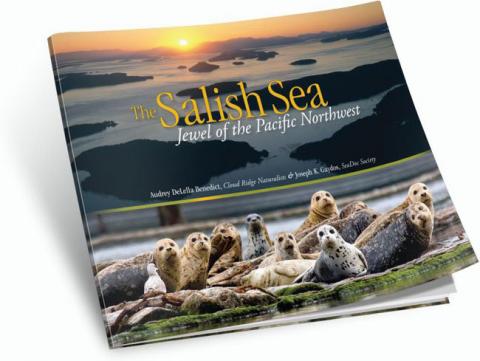
The Salish Sea: Jewel of the Pacific Northwest brings together more than 230 extraordinary images of the Salish Sea. But don't call it a coffee table book. Its lush photos are backed by a serious scientific perspective on this complex and fragile ecosystem.

The Puget Sound Model was designed and built by the University of Washington School of Oceanography in the early 1950s to simulate the tides and currents of Puget Sound. A series of videos produced by the Encyclopedia of Puget Sound describes its construction and operation.

The Puget Sound Model was designed and built in the early 1950s at the University of Washington School of Oceanography as a research and teaching tool for understanding Puget Sound circulation patterns.

The Salish Sea extends across the U.S.-Canada border, and includes the combined waters of the Strait of Georgia, the Strait of Juan de Fuca, Puget Sound Basin and the San Juan Islands (see map).

The name Salish Sea was proposed by Bert Webber in 1989 to reflect the entire cross-border ecosystem. Both Washington State and British Columbia voted to officially recognize the name in late 2009. The name honors the Coast Salish people, who were the first to live in the region.

More information on the ecology and naming of the Salish Sea is available from the SeaDoc Society and Western