Ecosystem-based management

The National Ocean Council defines Ecosystem-Based Management (EBM) as "an integrated approach to resource management that considers the entire ecosystem, including humans, and the elements that are integral to ecosystem functions. EBM is informed by science to conserve and protect our cultural and natural heritage by sustaining diverse, productive, resilient ecosystems and the services they provide, thereby promoting the long-term health, security, and well-being of our Nation." —National Ocean Council (2011)

Additional Information:

2012 Puget Sound Action Agenda

Related Articles

This paper summarizes a 2014 report ranking the greatest human-caused threats to the Puget Sound ecosystem. 

Every two years, statute requires the Puget Sound Partnership to produce a Biennial Science Work Plan (BSWP). Its primary purposes are to I) assess how well ongoing research addresses decision-­‐critical uncertainties relating to the recovery of Puget Sound; II) identify additional science needs for recovery; III) make recommendations for priority science actions in the coming biennium; and IV) suggest how science can better support recovery. This document is the third BSWP to be produced in the series, covering the 2014-­2016 biennium.

The 2009-2011 Biennial Science Work Plan specifies the use of the IEA framework by the Puget Sound Partnership "to
 refine 
indicators, 
assess 
risks, 
and
 evaluate
 strategies,
 integrating 
marine, 
nearshore, 
and 
terrestrial 
efforts."

The 2013 State of the Sound is the Puget Sound Partnership’s third report to the Legislature on progress toward the recovery of Puget Sound by 2020. The document reports on both the status of the Partnership's recovery efforts and the status of a suite of ecosystem indicators.

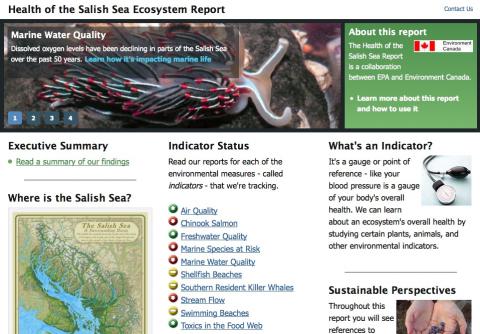
The 2013 Health of the Salish Sea Ecosystem Report was prepared jointly by the U.S. Environmental Protection Agency and Environment Canada. View the complete report, or read the Executive Summary below.


The Puget Sound Partnership is charged with preparing a State of the Sound report every two years to inform the legislature and the public on the status of restoration efforts in Puget Sound.