

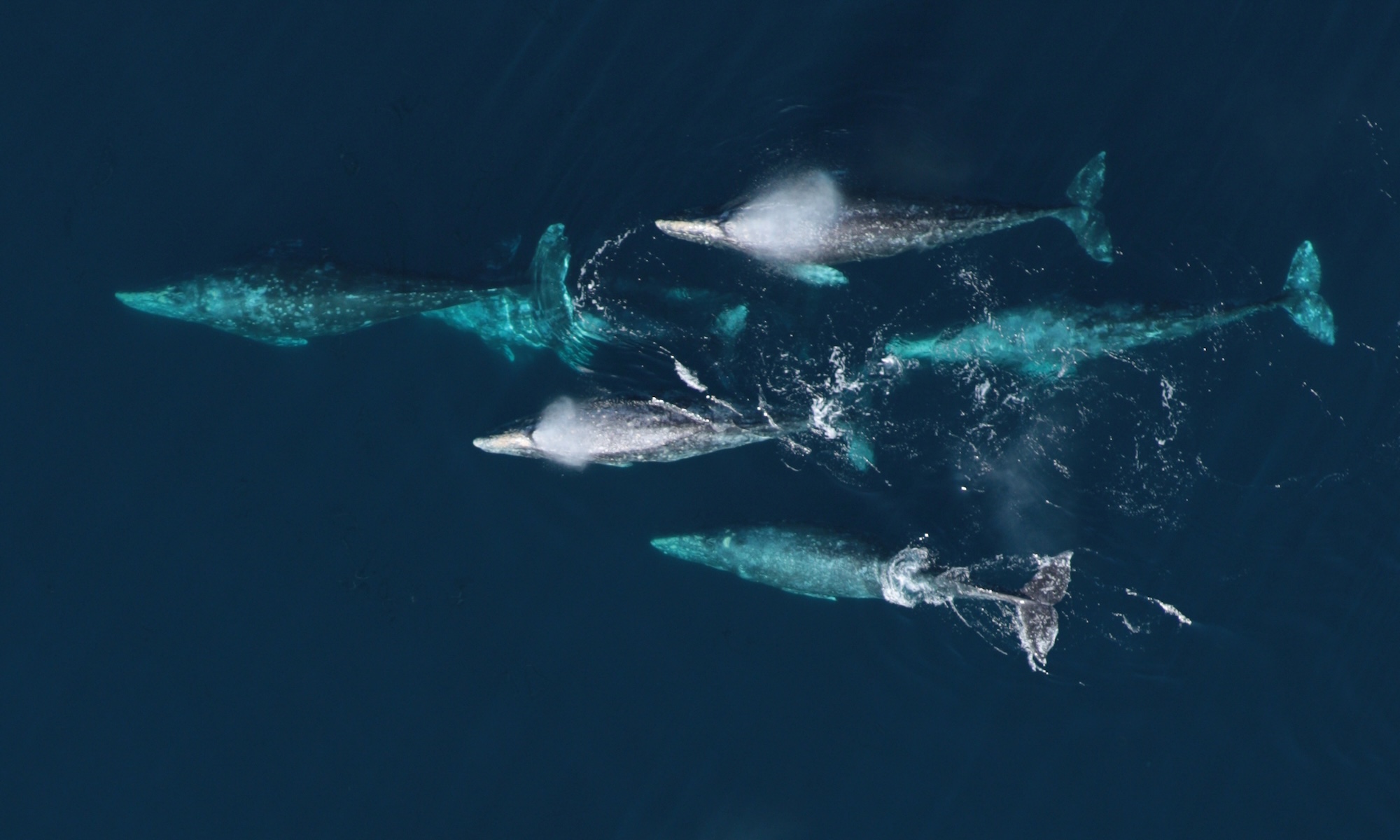
Sometime in the early months of 2020, a gray whale heading north along the California coast made a hard right swerve. He suddenly deviated from his species’ migratory pathway between winter mating and calving grounds in Baja California and summer feeding grounds in the Arctic Ocean, and entered the Golden Gate Strait.
Dodging container ships, pleasure boats, and ferries coming and going through the narrow hourglass neck of the Strait, the whale made it into San Francisco Bay where, in March, researchers spotted him, took his picture, and assigned him a number: CRC2259.
But he didn’t linger long in California waters. In early April, the whale with the distinctive sand-dollar-shaped patch of white skin on the left side of his back showed up more than 800 miles north, in Puget Sound.
CRC2259 had found his way to a rich buffet of meaty little mud-dwelling crustaceans called ghost shrimp (Neotrypaea californiensis) that a small group of gray whales, known affectionately as the Sounders, has been visiting the waters east of Whidbey and Camano Islands to gorge on since 1990.
He stayed in Puget Sound until mid-October, then returned the following spring (his second visit making him officially a member of the Sounders population), and again in 2022, 2023, and 2024. Then, in 2025, CRC2259 made that hard swerve into San Francisco Bay again. This time he wasn’t so lucky. On April 4, scientists from the Marine Mammal Center in Marin County spotted his carcass with signs of blunt force trauma, indicating that he had perished after colliding with a ship or boat.
CRC2259 is one of at least 30 gray whales (Eschrictius robustus) killed by vessel strikes in San Francisco Bay since 2018. Those deaths, in turn, contribute to an alarming mortality trend among gray whales in the eastern North Pacific that has seen the population decline by about one-third in recent years, from a high of around 27,000 individuals in 2016 to just 17,750 this year.
This crisis, thought to be driven by climate change-related declines in the whales’ Arctic prey but exacerbated by ship strikes and other more immediate human-caused hazards, was the subject of a Range-Wide Gray Whale Science Symposium in early September. Gray whales face a forbidding list of challenges to their survival but also display “adaptability and resilience in the face of environmental variability,” Lisa Ballance, director of Oregon State University’s Marine Mammal Institute, which hosted the conference, told the gathering.
CRC2259’s story is emblematic of both the bright and dark aspects of that theme, and links Puget Sound to the trajectory of the larger gray whale population. The Sounders have numbered just two dozen individuals over the last 35 years. But what they are doing in Puget Sound and why they keep coming back helps illuminate the struggles of the species as a whole – and how it might persist in a climate-changed world.
Safe space
Over the past several decades, Puget Sound has emerged as a haven during hard times for gray whales. The eastern North Pacific (ENP) population of the species is broadly considered a conservation success story, increasing from perhaps a few hundred individuals in the wake of industrial whaling to about 20,000 in 1994. That year, the gray whale was removed from the federal endangered species list – the first and only large whale species to have achieved that milestone.
But since their recovery, gray whales have also gone through boom-and-bust cycles. Thousands of gray whales are believed to have died during what NOAA/NMFS has termed “Unusual Mortality Events” (UMEs) in 1999-2000 and 2019-2023, characterized by spikes in strandings, plummeting calf counts, and sightings of many emaciated whales.
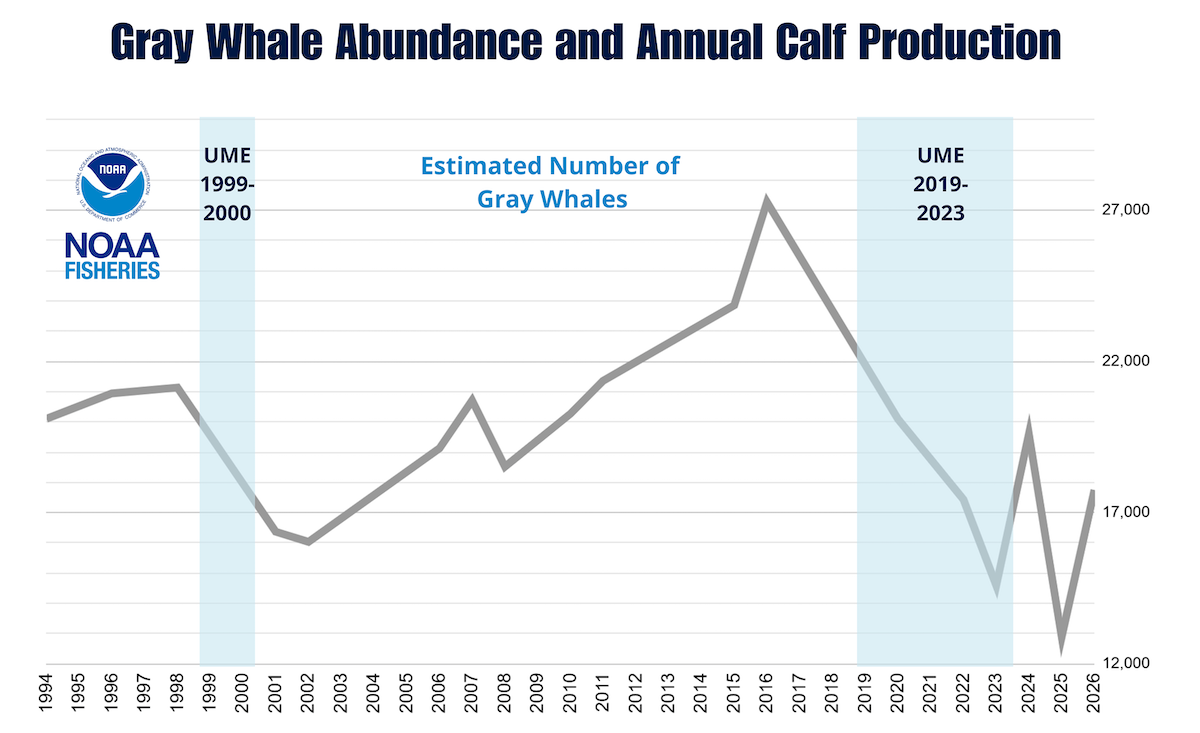
Combining decades’ worth of data on gray whale demographics, the ebb and flow of sea ice, and the biomass of the tube-dwelling crustaceans called amphipods that gray whales sieve from the muck at the bottom of the Arctic Ocean on their traditional foraging grounds, scientists determined that these population crashes happen when extensive Arctic sea ice cover coincides with low prey abundance.
In contrast to the ENP population as a whole, the Sounders have fared well during past UMEs. In fact, that’s when their ranks tend to swell with new recruits: seven new Sounders first visited during 1999-2000, and eight during 2019-2023, with CRC2259 among the latter cohort.
What’s more, the Sounders group was likely founded during a previous hard time for gray whales. Data on strandings in Washington going back to 1977 – perhaps the longest and most complete stranding record of any area along the gray whale migratory corridor – suggest that another peak in strandings occurred in 1990-91. This was not officially recognized as a UME (the UME program was started by Congress in 1992) but it corresponds to a period when modeling studies suggest a gray whale population decline.
Conventionally, gray whales fast while migrating and on their Baja California breeding grounds. But scientists believe that when gray whales don’t get enough to eat on their Arctic foraging grounds during the summer, they may not have the nutritional stores to make it back to the Arctic the following spring.
When whales first foray into Puget Sound, then, they are likely some combination of intrepid and desperate. They have essentially run out of fuel, and the ghost shrimp buffet serves as a pit stop that gets them through to the migration finish line. The whales remember the resource and may return the next year – or in a future year when they are especially hungry.
The Sounders represent one of several data points that “provide the ideal insight into what's going on with the overall eastern North Pacific gray whale population,” John Calambokidis, senior research biologist at Cascadia Research Collective, told Salish Sea Currents. (The “CRC” in the alphanumeric designations of gray whales stands for Cascadia Research Collective; the organization has coordinated gray whale photoidentification efforts along the West Coast since 1998).
Long-range reflections
After previous population crashes, gray whale numbers have quickly come roaring back. But although the most recent UME was declared “closed” in 2023, researchers have continued to observe high mortality, few calves, and lots of skinny whales. (A UME is a bureaucratic designation and may end either because the conditions associated with it have resolved or, as in this case, because they have become persistent.)
At the beginning of the last UME in 2019, 216 gray whales washed up dead along the West Coast of North America, followed by 172 in 2020. This year’s total of 187 stranded whales as of mid-August is in the same range, but even more worrisome because it occurs against a backdrop of a much lower total population.
Amid these persistent signs of trouble, more gray whales are adopting a strategy similar to the Sounders and seeking out alternative foraging grounds and stopover points on their northward migration. Multiple researchers at the symposium described how gray whales are showing up in new areas, congregating in dramatically increased numbers at known stopover points, or using these stopover points in new ways.
The number of gray whales feeding on spring herring spawn in Sitka Sound in southeast Alaska – around the halfway point of the migratory pathway – has “ballooned” from about 15 whales prior to the UME to around 250 in both 2025 and 2026, said Lauren Wild, assistant professor at the University of Alaska Southeast in Sitka.
Gray whale presence may also be increasing around Kodiak Island, off southwestern Alaska at the base of the Alaska Peninsula, according to Oregon State University assistant professor K.C. Bierlich. More gray whales have been seen feeding on herring spawn in the spring, with some sticking around through the summer rather than migrating onwards to the high Arctic.
“I think what’s impressive is the degree to which gray whales can be very specific to return to a certain spot to feed, and it’s almost like little groups of whales that have learned specific areas,” Calambokidis said during the symposium. “A particular gray whale might know a couple of these spots, and hit them on the way north.”
Along with these wider changes in gray whale migration patterns, the habits of the Sounders themselves are shifting. Historically, the Sounders have visited Puget Sound mainly between March and May. But since the most recent UME began, Sounders are arriving earlier in Puget Sound and staying longer.
“We’ve now seen almost a third of them forgoing the southern migration, arriving in December and feeding through spring to early summer. Some whales are staying year-round,” Calambokidis said. “So we’re seeing changes that reflect what’s going on in the larger population.”
Four of the five Sounders who arrived in December 2025 are known to be female. And fewer whales visiting the breeding grounds likely means fewer calves in years to come. “The implications of these whales choosing not to follow that basic instinct to go to Baja and go eat instead, to me are just mind-blowing,” Cindy Hansen, education and advocacy coordinator for Orca Network, which tracks real-time sightings of gray and other whales within Puget Sound, said in an interview with Salish Sea Currents.
Read more about our local gray whales in the Encyclopedia of Puget Sound
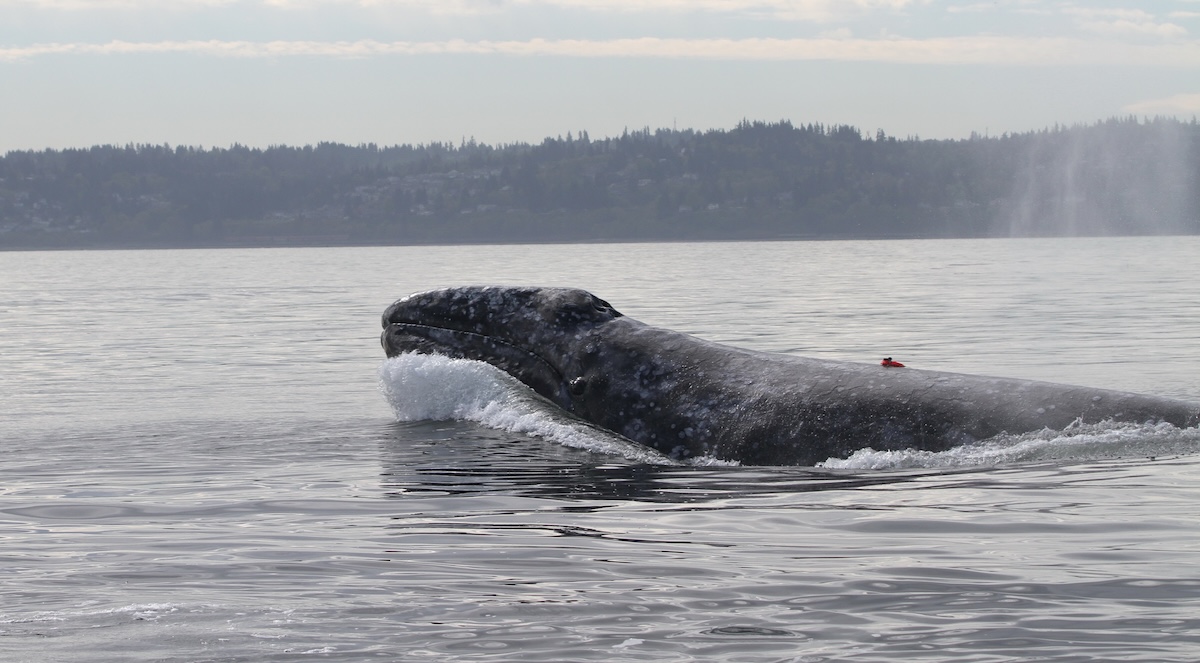
Learn more about Sounders and other groups of gray whales of the Salish Sea in this Encyclopedia of Puget Sound overview by John Calambokidis senior research biologist Cascadia Research Collective.
Opportunities and traps
The outside-the-Arctic feeding strategy exhibited by the Sounders is clearly more common than scientists appreciated in the past, but just how common is not yet known. “There might be other undiscovered refugia that enhance [gray whales’] resiliency across their range,” OSU associate professor Leigh Torres said at the symposium.
Torres studies the Pacific Coast Feeding Group (PCFG), a couple of hundred gray whales who for decades have fed along the Pacific Northwest coast in the summer rather than migrating to the Arctic. Like the Sounders, PCFG whales have been insulated from the dramatic boom-and-bust cycles of the larger ENP population. But their numbers have gradually declined by nearly 20% over the past decade, and the whales who remain are getting smaller and thinner.
“The PCFG might represent how an ecological opportunity can shift into an ecological trap due to environmental change,” Torres said.
That paradox of opportunity and trap may also describe San Francisco Bay, where gray whales like CRC2259 have been appearing since 2018. A total of 114 whales were seen between 2018 and 2025, according to a paper published in April. Just eight of those whales were members of known subgroups like the Sounders or PCFG, suggesting that these are migratory whales seeking a new stopover place, not an existing subgroup extending its range.

But that same analysis documented that 18% of gray whales who enter the Bay die there. And about 40% of gray whales who die in or just outside San Francisco Bay die from vessel strikes. Many of the 70 whales who were found dead in the area between 2018 and 2025 have also been malnourished.
At some emerging stopover points, it’s not always clear whether the whales who congregate there are getting the nutritional resources they need. More than 100 whales were seen outside the mouth of Grays Harbor on Washington’s outer coast during the summer of 2025, according to data from a poster Calambokidis presented at the symposium. The majority of these whales had never been identified previously.
Meanwhile, 15 whales were observed feeding inside Grays Harbor that summer. Nine of these whales were known to be members of the PCFG, and 13 of them had been seen in the area in previous years.
A map of these phenomena on the poster, with individual whale sightings represented as small squares outlined in white, is strangely haunting: How did the whales inside Grays Harbor find their way in and learn how to take advantage of the resources there, and why were the whales outside seemingly unaware of the rich feeding grounds just a few miles away?
Ghost grazing
A little way North, around the corner of Cape Flattery, and through the narrow chute of Admiralty Inlet, the dynamics of gray whales in Puget Sound may offer some clues about what makes an alternative foraging ground a successful one, and why some individual whales but not others are able to learn how to take advantage of those resources.
For one thing, the ghost shrimp that the Sounders feed on are highly nutritious, says Hannah Clayton, a graduate student in the laboratory of Jeremy Goldbogen at Stanford University. They are about as calorie-dense as forage fish such as herring and smelt, “which are really high value, high calorie prey for other baleen whales,” Clayton told Salish Sea Currents in an interview.
Like the gray whales’ traditional Arctic amphipod prey, ghost shrimp live in soft sediment, and gray whales are adapted for bottom-feeding, with a long head and a wide, flat lower jaw. Clayton has calculated that the foraging efficiency of gray whales feeding on ghost shrimp is about on par with that of blue whales – highly specialized and efficient foragers – feeding on krill. Detouring to Puget Sound is a net energetic benefit compared to feeding exclusively in the Arctic, even in the best Arctic conditions, according to unpublished data that Clayton presented in a poster at the symposium.
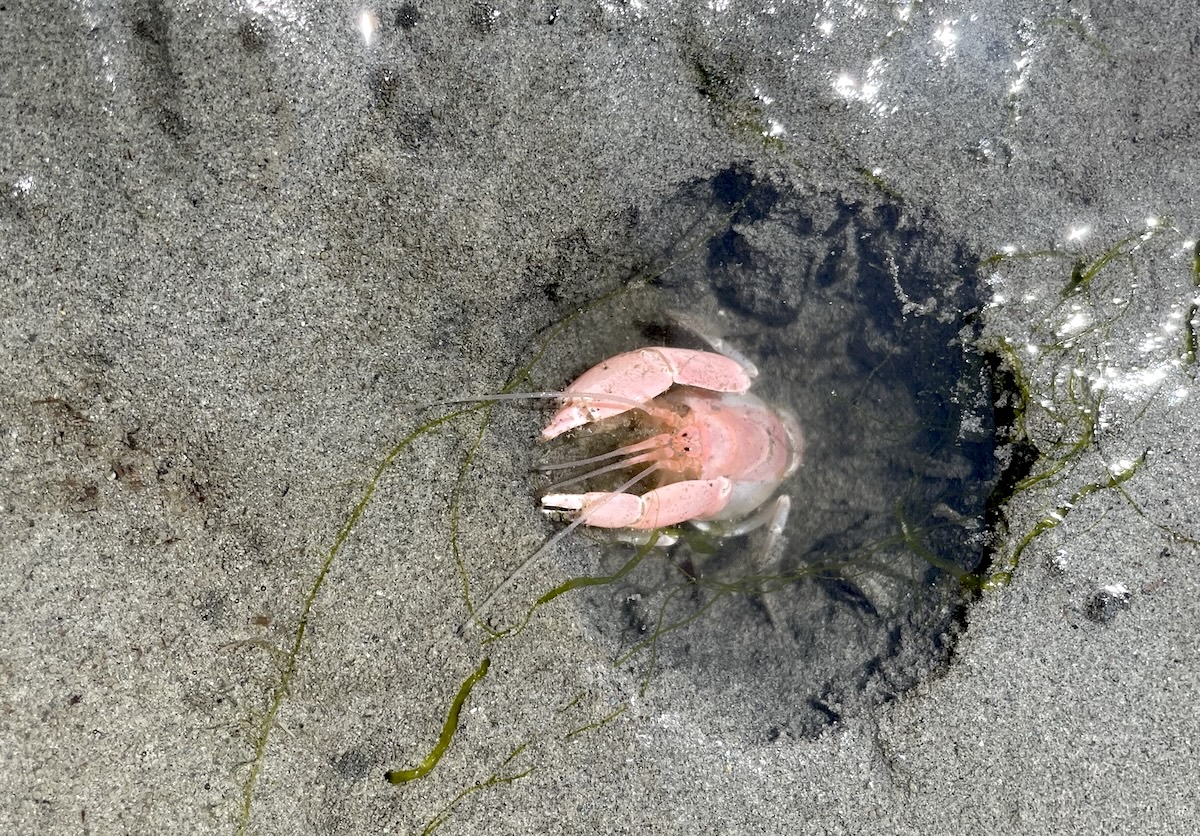
“I think this just highlights that [Puget Sound] is a very important foraging ground for these whales, and may explain why,” she says. Drone photographs of experienced Sounders show that these whales become noticeably fatter over the course of just weeks feeding in Puget Sound.
But the feeding strategy is also a high-risk one. Ghost shrimp live in the intertidal zone, and the whales must time their meals with the high tide, feeding in water barely deeper than their own bodies. Inexperienced whales have sometimes temporarily live-stranded when the tide has gone out, although there have been no fatalities to date.
Especially in high-mortality years, gray whales that scientists refer to as “migration stragglers” are seen in Puget Sound. These newcomers are emaciated whales who wander in parts of Puget Sound that are not productive feeding areas. Some of these whales eventually perish in Puget Sound, or leave and never return.
Others manage to learn the ropes. One whale who became a long-time Sounder, Dubnuck (CRC44), spent more than a month in southern Puget Sound when he first came to the area in the spring of 1991. He found his way to the ghost shrimp foraging grounds in the northern part of Puget Sound later in the season, and ultimately returned nearly every spring for the next 32 years.
Some scientists suspect that whales who are new to Puget Sound may learn how to feed on ghost shrimp from the more experienced Sounders. One video from a suction-cup tag attached to the back of Earhart (CRC22), one of two original Sounders who first visited in 1990, revealed a group of newer whales following her into the shallows. This year, two whales who are new to Puget Sound, CRC2686 and CRC2687, have been repeatedly seen feeding near Little Patch (CRC53), who has been coming to Puget Sound since 1991.
Social learning is known to be involved in the diffusion of bubble net feeding among humpback whales. But whether similar relationships play a role in the recruitment of new Sounders – or in helping gray whales learn how to take advantage of other alternative foraging areas – will require more study, researchers say.
Good neighbors
Additional pressing research questions include to what degree Puget Sound can continue to support Sounders and other hungry gray whales, and how to address other threats they may face while they are in the area.
The ghost shrimp beds in northern Puget Sound that the Sounders rely on are also the target of a commercial harvest for use as fishing bait. In a 2016 study (PDF link), the Washington Department of Natural Resources determined that the commercial harvest would not interfere with the Sounders’ food supply. The agency limited the harvest to times of year outside the whales’ typical spring visits.
“Things have changed so much since that [study] was done,” Hansen says. With more gray whales coming earlier, staying for longer periods, “what impact is that having on the ghost shrimp, and what impact is a harvest having on the ghost shrimp that might be impacting the gray whales?”
Calambokidis is seeking funding to investigate how the Sounders’ new habits are affecting the ghost shrimp population and whether the ghost shrimp stocks are likely to be able to support the presence of more gray whales for longer durations. He and other scientists are also concerned about other risks to gray whales in Puget Sound such as entanglement in fishing gear and collisions with boats. Some migration stragglers have been killed by vessel strikes, and Sounders – including Earhart – have experienced non-fatal collisions while in Puget Sound.
In San Francisco Bay, AI-assisted thermal cameras that can recognize whales’ exhaled breath have been deployed starting in May 2026 in an effort to reduce ship strikes like the one that killed CRC2259. The cameras provide real-time updates on where gray whales are in the Bay, so that vessels can slow down or maneuver to avoid them. Eventually, data on where and when whales tend to be present most may allow officials to shift ferry and shipping routes away from the whales’ preferred pathways.
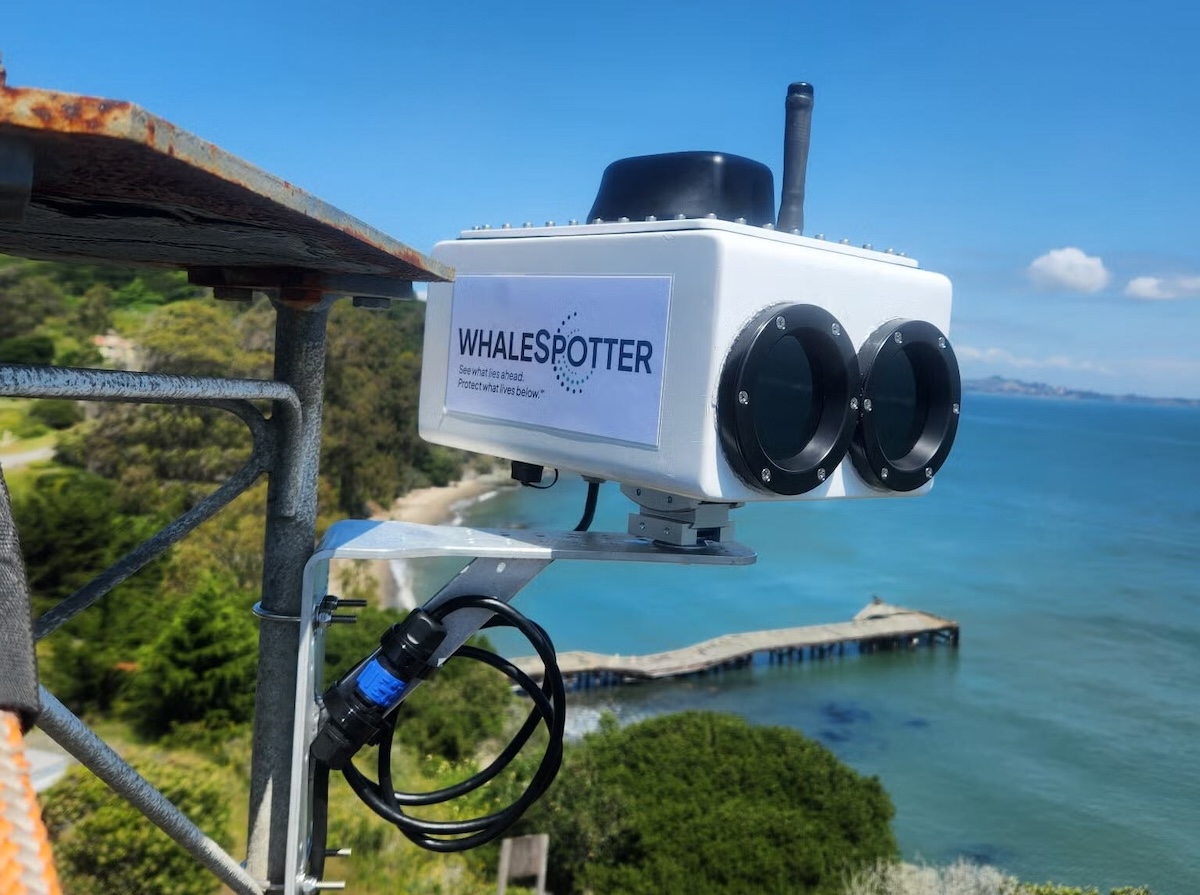
“It’s a really unique and exciting thing to have megafauna in a metropolis,” Douglas McCauley, director of the Benioff Ocean Science Laboratory at the University of California, Santa Barbara, said during a May 19 press conference launching the WhaleSpotter thermal detection system in San Francisco Bay. Their presence is bittersweet, he added, since “this is also a front-row seat to climate change occurring in our backyard.” But, he said, “We’re helping them adapt like we would for any other neighbor.”
McCauley’s comments echo the sentiments and cultural ethos that have grown up around the Sounders, beloved whales navigating busy urban waterways, climate change-related disruption to their Arctic feeding grounds, and other emerging threats.
And the September symposium suggested that these attitudes are now broadly shared across the gray whale’s range. “We should take hope in their behavioral adaptability,” Torres told the gathering. “I think the gray whales will find these pockets to survive these hard times and find new food sources. And I think management-wise, we just need to recognize those, monitor those, and help them survive.”