Marine habitat

The Marine System encompasses all coastal areas not appreciably diluted by freshwater (surface salinities seldom falling below 30 ppt), including open coastal areas, straits, and euhaline inland waters.  It can extend from the outer edge of the continental shelf to (1) the landward limit of tidal inundation or wave splash or (2) the seaward limit of the Estuarine System.

Source:

Dethier, M.N. 1990. A marine and estuarine habitat classification system for Washington State. Natural Heritage Program, WA DNR, Olympia, WA. 60 pp.

Overview

Each year, the Puget Sound Ecosystem Monitoring Program releases the annual Puget Sound Marine Waters Overview report. The latest report combines a wealth of data from comprehensive monitoring programs and provides a concise summary of what was happening in Puget Sound’s marine waters during 2022. The report represents the collective effort of 84 contributors from federal, tribal, state, and local agencies, academia, nonprofits, and private and volunteer groups.

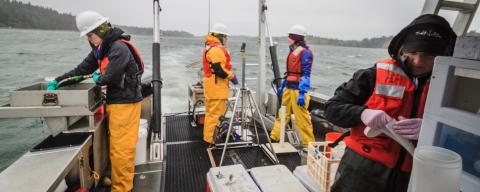
Image of a sailboat on the water at sunset.Text overlay reads: Puget Sound Marind Waters 2022 Overview.

Related Articles

A state law going into effect this month will significantly increase funding for the cleanup of abandoned and derelict vessels in Puget Sound. The funding will add about $4.3 million annually to remove hazardous sunken wrecks and related pollutants.

New research suggests that recovery efforts are working for Puget Sound’s threatened yelloweye rockfish. Preliminary models show "considerable improvement" in population numbers.

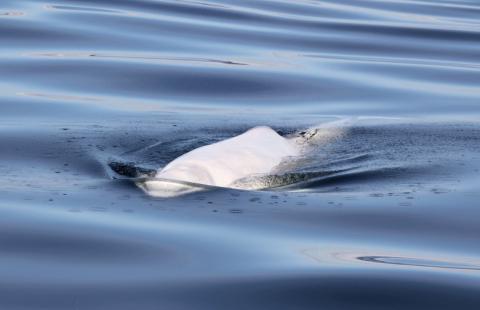
A series of beluga whale (Delphinapterus leucas) sightings in southern Puget Sound in October 2021, added a new set of records for the species in this region. The 2021 event represents the longest period of time a beluga has been observed so far south of Alaska, in the eastern North Pacific. This may have just been an isolated event of a single extralimital individual. Alternatively, it may suggest a potential range expansion that could portend future increased visits by this species in the Pacific Northwest, especially if warming of Arctic waters continues.

The winter was cold and wet, resulting in a good snowpack in the mountains to sustain river flows into summer. In Puget Sound, saltier waters in summer transitioned to fresher conditions by fall 2021. Water temperatures in late winter 2022 are now colder and oxygen levels are high. From the air, Puget Sound looks spectacular, with few events to report. First signs of the spring bloom were visible in protected bays and passes. Port Susan and Carr Inlet already show sizable patches of drifting organic material. Small jellyfish patches were  present in Eld Inlet.

The marine heat wave that struck the Pacific Ocean in late 2013 also caused large changes in temperature in the Salish Sea, but scientists are still puzzling over the impacts of those changes on Puget Sound's food web. The so-called "blob" of warmer than average water was thought to have increased the production of plankton, which potentially benefits creatures like herring and salmon that feed on the tiny organisms. A new paper in the journal Frontiers in Marine Science calls that interpretation into question, pointing to a computer model that links the cause to higher-than-normal river flows in the region.   

Large plumes of methane bubbles have been discovered throughout the waters of Puget Sound prompting questions about the Puget Sound food web, studies of earthquake faults and climate-change research.