Eyes Over Puget Sound

The Washington State Department of Ecology distributes a monthly report combining high resolution aerial photographs with satellite and ground-truthed monitoring data for Puget Sound surface conditions.

Visit the Eyes Over Puget Sound website

Overview

Once a month, Washington State Department of Ecology marine scientists take to the air to obtain high-resolution aerial photo observations and gather water data at the agency's monitoring stations and via state ferry transects. This provides a visual picture of the health of Puget Sound, which they call Eyes Over Puget Sound or EOPS.

The float plane prepares to take off. Photo by Jeff Rice for the Encyclopedia of Puget Sound.

Related Articles

This summer river flows were generally lower than in 2020. And in August, high air temperatures and low precipitation continued, following a drought emergency declaration in mid-July that affected also marine conditions.  The higher-than-normal salinity anomaly which persisted during summer in Puget Sound marine water is, however, eroding away, and lower-than-normal oxygen conditions developed in Central Sound in the month of August. Many blooms and organic material were reported by citizens throughout summer, and by September many colorful blooms in bays across the region continue to be active. Patches of macro-algae and organic debris are still numerous in South and Central Sound and in Padilla Bay. Jellyfish are occurring in unusual places. While we document water quality issues, we are also showcasing the natural beauty of Puget Sound through photography.

Despite a La Niña, precipitation and rain have been lower since March, leaving only snow-fed rivers running high. Due to lower rainfall and warm summer temperatures the salinity of Puget Sound is now generally higher. Strong blooms and large patches of organic material and macro-algae are building up in many places and wash onto beaches. During very hot summer days, tidal mudflats and beaches can get really warm. Beach wrack can harbor increased bacteria numbers now. See SCUBA cleaning up at Redondo beach.

After a wet winter/spring transition it has been noticeably drier, warmer and sunnier. River flows are near normal levels and in Puget Sound and coastal bays salinity is increasing above normal. The spring bloom is developing but not very pronounced, yet, Noctiluca is already visible in southern Hood Canal. Suspended sediment near rivers and creeks, failing bluffs, and shellfish activities are frequent. Capturing herring spawning from the plane is informative; pilots share their observations.

We are in a weakening La Niña, coastal downwelling has lessened and we are getting out of a cold and wet stretch, hurray. In March, rivers have almost returned to normal and carry clear water. It’s a good time to go diving if you don’t mind cold water. The productive season has only started in some places and patches of jellyfish are visible. Have a look at this edition and marvel about the secrets of the dead, or mysterious sediment clouds and the oil sheen spotted near Lummi Bay.

Rivers are flowing higher than normal since 2020. Winter weather has been warmer and wetter. In marine waters, temperatures have become too cool for Northern Pacific anchovies to tolerate in North Sound. From patches of jellyfish and snow geese, to sediment and early blooms, there is more happening in the winter than you might expect. Puget Sound has many species worth showcasing such as the heart crab – a shy critter that wears its heart on its shell.

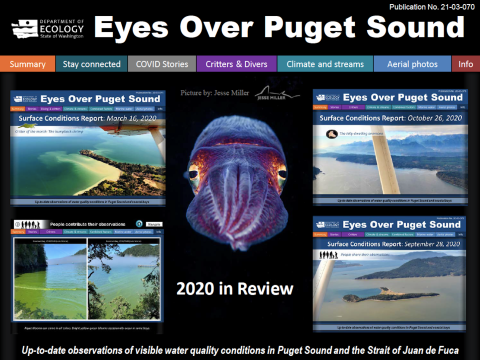
The Washington State Department of Ecology has prepared a summary review of its Eyes Over Puget Sound surface condition reports from 2020.