Eyes Over Puget Sound

The Washington State Department of Ecology distributes a monthly report combining high resolution aerial photographs with satellite and ground-truthed monitoring data for Puget Sound surface conditions.

Visit the Eyes Over Puget Sound website

Overview

Once a month, Washington State Department of Ecology marine scientists take to the air to obtain high-resolution aerial photo observations and gather water data at the agency's monitoring stations and via state ferry transects. This provides a visual picture of the health of Puget Sound, which they call Eyes Over Puget Sound or EOPS.

The float plane prepares to take off. Photo by Jeff Rice for the Encyclopedia of Puget Sound.

Related Articles

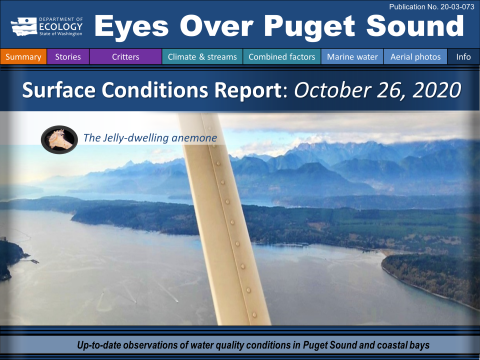
After a relatively warm summer and fall, and La Niña forming in the tropics, stream flows in the Puget Sound region are now relatively normal. Summer in Puget Sound produced lots of algal and organic material in the water and on beaches, which by October have disappeared. Kelp beds look strong in northern Puget Sound and the Straits; and the harvest of the annual chum salmon run is in full swing in Hood Canal. Jellyfish aggregations are visible in Budd and Sinclair Inlets — and some of the jellyfish might conceal a beast of another kind within. Oil sheens on the water are currently numerous.

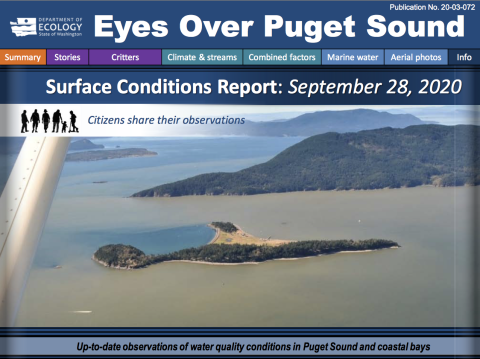
A warm and dry summer ended with a smoky September due to massive wildfires that were followed by strong rain. As a consequence, muddy river plumes in Puget Sound are very visible, especially near the Nooksack River. During summer, many wonderful citizen contributions documented the large formation of organic material in Central Sound and helped us cover the gap in EOPS flight from April-September. By September when we started flying again, a few bays still had red-brown blooms. Nevertheless, schools of fish are abundant, and jellyfish are sparse, which is good news. Meet our new ocean acidification experts.

After a wet January, precipitation has been low and air temperatures have been cooler.  As a result, rivers gages are lower than expected, a pattern that has continued since last year. In March we approached the coldest water temperatures of the year. Herring are spawning in Port Madison. Although these cool temperatures are good for herring, temperatures are close to the survival limits for anchovies. If you can handle these temperatures, now is a good time to go diving to benefit of good underwater visibility, just avoid windy days near wave-exposed beaches. If you are lucky, you might see the kelp humpback shrimp, a master of camouflage.

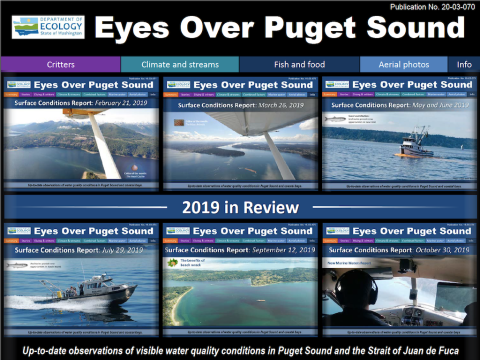
The Washington State Department of Ecology has prepared a summary review of its Eyes Over Puget Sound surface condition reports from 2019. The year started with snow, and a summer drought kept river flows low. As a result, salinities in Puget Sound were elevated year round. Warmer surface water temperatures in spring gradually extended to greater depth by late summer. The spring bloom was strong, and South Sound provided optimal conditions for anchovies that showed up in high numbers. A coccolithophore bloom stained Hood Canal turquoise, and Port Angeles and Discovery Bay were colored red-brown by strong blooms. Noctiluca and macroalgae, both known eutrophication indicators in coastal regions, were abundant in Central Sound, and extended into South Sound and Whidbey Basin. Large numbers of jellyfish occurred in Quartermaster Harbor, Sinclair Inlet, and parts of Orcas Island.

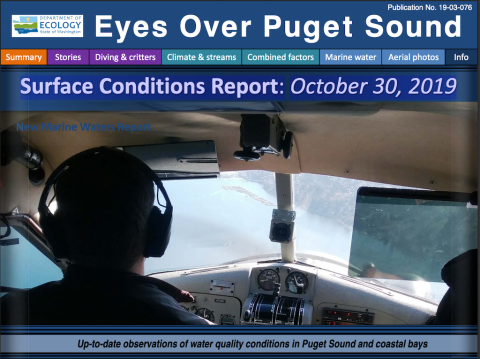
After a dry early summer followed by more than expected rain, rivers mostly remained lower than in 2018. In October air temperatures dropped, but water temperatures remained warm enough for spawning anchovies in South and Central Sound and herring and salmon optimal growth in Whidbey Basin. By the end of October many red-brown blooms vanished, yet the waters of South Sound are still green, adorned with rafts of organic debris in many places. Read what happened the year before in the Puget Sound Marine Waters 2018 Overview.

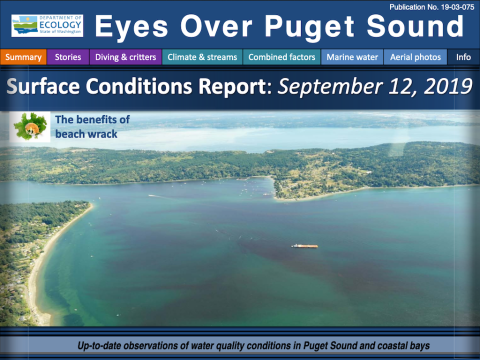
This year, air temperatures were warmer than in previous years, and this pattern is predicted to continue. Precipitation was low and is now improving, yet river flows remain low. By August, Puget Sound surface water temperatures were 0.6 °C warmer across all regions; this could have shifted the timing of optimal temperatures for some marine organisms. In September, blooms are limited to inlets. Jellyfish are abundant in Sinclair Inlet, and anchovies reside in Eld Inlet. Macroalgae are still plentiful. Learn about the benefits of beach wrack and a DNA barcoding project supported by Ecology.