Eyes Over Puget Sound

The Washington State Department of Ecology distributes a monthly report combining high resolution aerial photographs with satellite and ground-truthed monitoring data for Puget Sound surface conditions.

Visit the Eyes Over Puget Sound website

Overview

Once a month, Washington State Department of Ecology marine scientists take to the air to obtain high-resolution aerial photo observations and gather water data at the agency's monitoring stations and via state ferry transects. This provides a visual picture of the health of Puget Sound, which they call Eyes Over Puget Sound or EOPS.

The float plane prepares to take off. Photo by Jeff Rice for the Encyclopedia of Puget Sound.

Related Articles

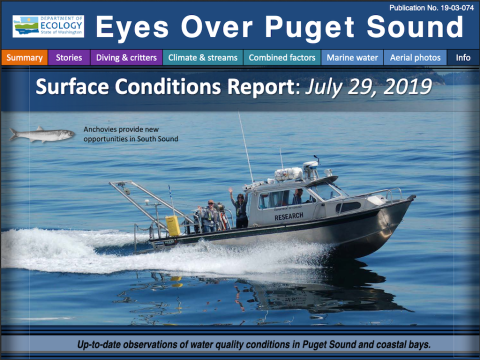
In July, the recent trends of warm, dry conditions lessened; however, river flows remain low. Extensive macroalgae drifted through South and Central Sound and washed up on beaches. Macroalgae growth is fueled by excessive nutrients and sunshine. When it washes onto the beach, it is called beach wrack, and it can be a health risk to beachgoers because of bacteria it can harbor. From our aerial photography, we saw that Southern Hood Canal looks tropical because of a bloom of coccolithophores coloring the water turquoise. Schools of fish congregate in South Sound and southern Hood Canal. Jellyfish are abundant in Quartermaster Harbor.

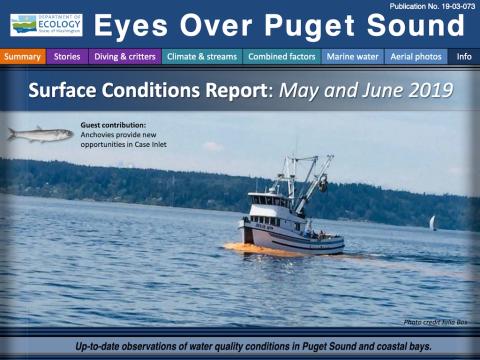
Warm and dry conditions this spring are predicted to persist into summer, resulting in saltier and warmer than normal Puget Sound water conditions. Early upwelling and a premature melt of the snowpack means nutrient-rich ocean water likely already entered Puget Sound. This sets the stage for a lot of biological activity. From the air, it is obvious that the productive season is in full swing. We saw large algae blooms in Central Sound along with abundant Noctiluca.  Huge numbers of anchovies were documented in Case Inlet and other finger inlets in South Sound, attracting hundreds of marine mammals.

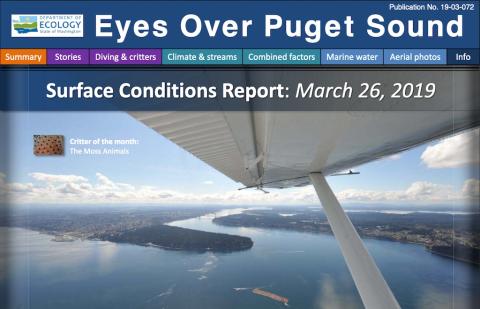
Following a generally warmer and drier winter and then a cold spell in February, Puget Sound waters are cold for anchovies. The productive season is in full swing with algal blooms spotted in South Sound, Kitsap Peninsula, and Quartermaster Harbor. Jellyfish are abundant in some inlets, and Noctiluca stains the water orange in Hood Canal. We collect monthly data to keep you informed about the conditions around Puget Sound. Come into the lab and see how we assure the highest data quality from our field instruments!

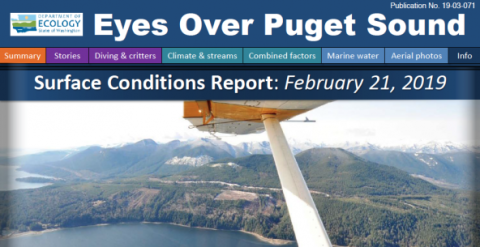
Although fall and winter were warm, February brought cold snowy weather and low river flows. Despite colder air temperatures, the productive season has already started in Hood Canal and Holmes Harbor. Puget Sound waters were warmer than expected through January, and the warmest waters were in Hood Canal, possibly creating a thermal refuge for cold-sensitive species such as anchovies. We saw lots of sea lions feasting on anchovies in Case Inlet, and we may have captured some herring spawning activity. Unusual for mid-winter, we saw jellyfish patches in Eld and Budd inlets. See the new publication about ocean acidification featuring twenty-five years of our marine monitoring data!

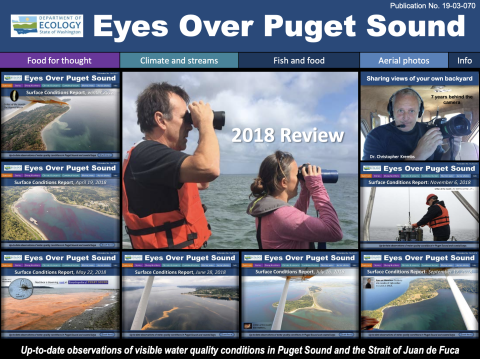
In 2018, water temperatures were slightly warmer than normal. Aerial photos revealed many spawning herring and baitfish as well as algal blooms. We also saw abundant macro-algae, a persistent Noctiluca bloom, and countless red blooms. Were these observations related to the cool, wet spring followed by a warm, dry, and sunny summer? Or did the neutral boundary conditions in the Pacific Ocean also play a role? A full summary is available in the report. 

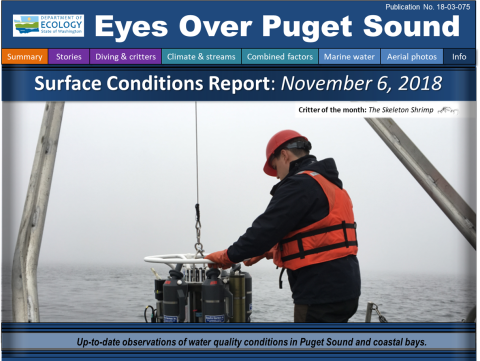
This fall, elevated air temperatures, lower precipitation, and lower river flows generally persisted; this aligned with fall and winter climate predictions. Following a warm summer, October water temperatures dropped back to optimal ranges for many fish. Puget Sound water has cleared and visibility has increased as the productive season ends making it easier to document jellyfish and schools of fish in the inlets of South Sound. While these flights generate a lot of attention, the majority of our monitoring in Puget Sound is now done via boat!