Eyes Over Puget Sound

The Washington State Department of Ecology distributes a monthly report combining high resolution aerial photographs with satellite and ground-truthed monitoring data for Puget Sound surface conditions.

Visit the Eyes Over Puget Sound website

Overview

Once a month, Washington State Department of Ecology marine scientists take to the air to obtain high-resolution aerial photo observations and gather water data at the agency's monitoring stations and via state ferry transects. This provides a visual picture of the health of Puget Sound, which they call Eyes Over Puget Sound or EOPS.

The float plane prepares to take off. Photo by Jeff Rice for the Encyclopedia of Puget Sound.

Related Articles

Air temperatures have remained high with precipitation and river flows below normal, extending the summer’s unusual conditions. Water temperatures were warmer in August, perhaps too warm for bull kelp and some salmon species in South Sound. In contrast, Hood Canal, North Sound, and the San Juan Islands provide optimal growth temperatures for herring and salmon. Many terminal inlets of Puget Sound are experiencing extensive red-brown blooms. Jellyfish patches are developing in South Sound finger Inlets and remnants of floating macroalgae occur in the nearshore areas of South Sound and in Useless Bay. At times floating organic material we see from the air ends up on the shoreline were our BEACH team documents it.

Its summer! River flows are generally below normal levels in response to low precipitation and warm air temperatures. Algae blooms are causing intense red-brown colors in Bellingham and Samish Bays, as well as in some other bays. Infrared images revealed that the algal blooms are in water exceeding 15°C. These warmer waters increase the risk of harmful algal blooms if toxin-producing species are present. Large rafts of macroalgae are drifting at the surface in South and Central Sound, and are particularly extensive in Carr Inlet, Commencement Bay, and Port Madison. Our Washington Conservation Corps Intern shares her many perspectives on Puget Sound.

During June, near normal air temperatures and continued low precipitation have resulted in highly variable freshwater inputs to Puget Sound. A large Noctiluca bloom extends across the South Central Basin of Puget Sound. Coccolithophores are blooming in Hood Canal. Macroalgae is drifting as mats on the water in Port Madison, South Central Basin, and South Sound. They are also piling up on beaches in South and Central Puget Sound and Whidbey Basin. Juvenile fish are migrating out of the estuaries and meeting a complex thermal habitat. New infrared images tell the story. Meet our ocean acidification expert, Stephen Gonski.

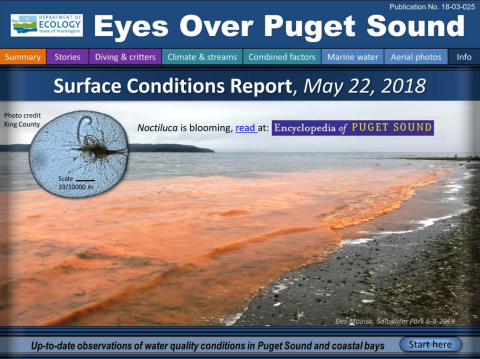
Rainfall in May was extremely low: The third lowest amount ever recorded. Rivers are responding differently depending upon whether they received water from rain or snow, which is melting rapidly. With projected drier and warmer conditions, can the remaining snowpack maintain healthy streamflows this summer? Seawater is already getting saltier than normal in response to the lack of rain. We see algal blooms in many colors. What is that orange stuff out there? It’s a Noctiluca bloom and organic material drifting at the surface stretching from South to Central Sound and Whidbey Basin.

By March, regional impacts of large-scale climate patterns normalized, and air temperatures, precipitation, and coastal downwelling were below normal. April brought abundant rain and rivers responded. With La Niña returning to ENSO-neutral conditions, will the favorable snowpack maintain beneficial streamflows through summer? In 2018, water conditions in Puget Sound are mostly expected, except in Hood Canal where conditions only changed recently. Many rivers and field drainage ditches release sediment. A strong red-brown bloom is present in Sinclair Inlet, a bright- brown bloom in Padilla Bay (Joe Leary Slough), and a bright green bloom in Bellingham Bay. It is colorful out there! You might see our team on the water sampling sediments this month.

Large-scale climate patterns and local weather patterns are returning to more normal conditions. La Niña helped build a favorable snowpack, projected to persist well into spring due to cooler weather. As a consequence, stream flows are largely normal. In Puget Sound, we see again normal water conditions and observe early spring blooms in Central Sound, northern Hood Canal, and Whidbey Basin. Herring are spawning in Admiralty Reach and further north. Salmon Bay in Seattle continues to have frequent oil sheens on the water.