Eyes Over Puget Sound

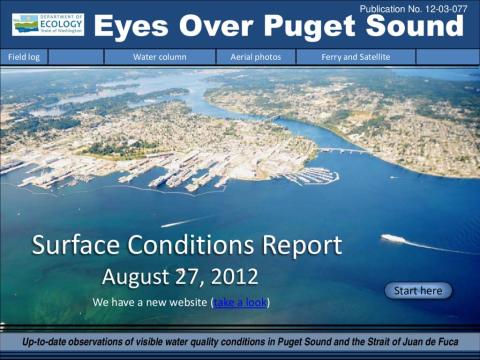
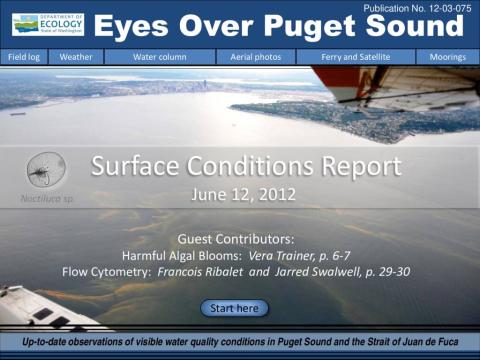
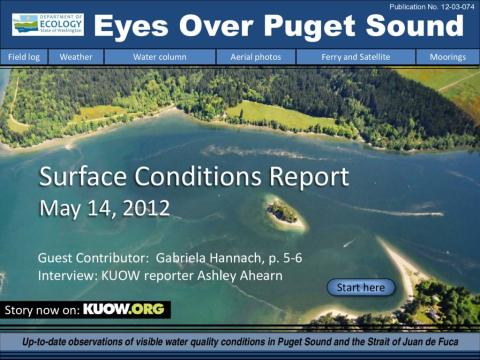
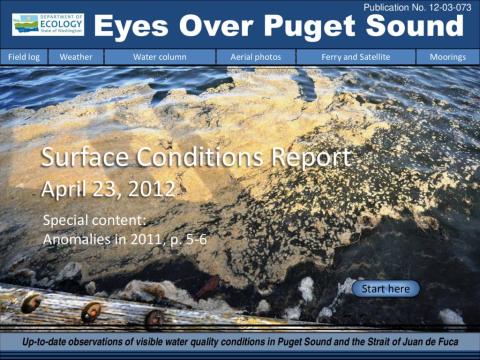
The Washington State Department of Ecology distributes a monthly report combining high resolution aerial photographs with satellite and ground-truthed monitoring data for Puget Sound surface conditions.

Visit the Eyes Over Puget Sound website

Overview

Once a month, Washington State Department of Ecology marine scientists take to the air to obtain high-resolution aerial photo observations and gather water data at the agency's monitoring stations and via state ferry transects. This provides a visual picture of the health of Puget Sound, which they call Eyes Over Puget Sound or EOPS.

The float plane prepares to take off. Photo by Jeff Rice for the Encyclopedia of Puget Sound.

Related Articles

Temperatures in Main Basin drop below 15 °C. Marco algae in Central Sound. Red-brown blooms in South Sound Inlets and parts of Central Sound. Jellyfish patches increasing in size in Sinclair and Budd Inlets. Low-Moderate fluorescence and turbidity in Main Basin and Admiralty Inlet.
In the south a persistent marine layer over the lowlands keep conditions cooler. River flows are high. Water temperatures approach 15 °C. High fluorescence in the Main Basin Extensive red-brown blooms in South Sound. In Whidbey Basin, higher DO and algal bloom in surface waters.
Cool weather and river flows above normal. A bonanza of red-orange Noctiluca streaks in Central Basin with reduced fluorescence south of Edmonds. Strong red-brown bloom in Case Inlet. Higher DO levels in Whidbey Basin surface water. Oil sheen in Sinclair Inlet.
Warm, sunny weather with higher-than-normal river flows. Temperatures above 13 °C . Strong algal blooms South Sound and Central Basin and most smaller bays. Dissolved oxygen levels in surface waters decrease despite high algae production. Abundant debris lines. Oil sheen in Lake Union.
Warm, sunny weather and higher-than-normal river flows . The freshwater layer in Whidbey Basin increased by 2 m. Abundant surface debris and algae blooms in river-fed inlets in South and Central Sound. Puyallup plume extends into Quartermaster Harbor. New thermosalinograph installed on ferry.
Cool, wet, cloudy weather with higher-than-normal river flows. Spectacular river plumes, suspended sediment and wind extend far into the waterways. Surface debris abundant. The freshwater layer in Whidbey Basin increased by 2 m matching high precipitation.