Monitoring

Monitoring encompasses the routine measurement of ecosystem indicators to assess the status and trends of ecosystem structure and function. Broadly, there are two goals for monitoring in the Puget Sound ecosystem. The first goal is to monitor status and trends of the ecosystem. This may take the form of snapshots of specific regions, or, more usefully, status monitoring tracks variability in carefully selected indicators over time. Status monitoring is fundamentally concerned with documenting spatial and temporal variability in ecosystem components and thus ideally relies on consistent long-term monitoring in a network of sites. A second aim of monitoring is to evaluate the effectiveness of management strategies. Effectiveness monitoring thus aims to detect changes in ecosystem status that are caused by specific management actions.

Sources:

Puget Sound Science Review

Additional resources:

Puget Sound Ecosystem Monitoring Program

Eyes Over Puget Sound

Overview

The Puget Sound Ecosystem Monitoring Program (PSEMP) is an independent program established by state and federal statute to monitor environmental conditions in Puget Sound. 

PSEMP logo

Related Articles

The removal of shoreline armoring has become a priority for the state's Puget Sound recovery efforts. The Puget Sound Ecosystem Monitoring Program (PSEMP) is providing details on the effectiveness of armor-removal projects at 49 study sites.

In Washington State, the pinto abalone (Haliotis kamtschatkana) has declined by 97 percent since 1992 and is unlikely to recover without intervention. A captive rearing and restocking pilot study shows promise for saving wild populations from local extinction.

The sunflower sea star (Pycnopodia helianthoides) is highly susceptible to sea star wasting disease. The authors of a 2019 paper published in Science Advances document the rapid, widespread decline of sunflower stars and discuss the ecological implications of losing this important subtidal predator species.

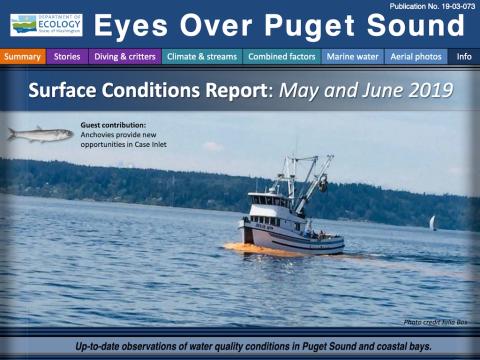
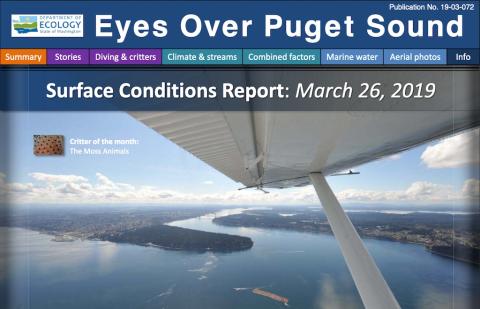
Although fall and winter were warm, February brought cold snowy weather and low river flows. Despite colder air temperatures, the productive season has already started in Hood Canal and Holmes Harbor. Puget Sound waters were warmer than expected through January, and the warmest waters were in Hood Canal, possibly creating a thermal refuge for cold-sensitive species such as anchovies. We saw lots of sea lions feasting on anchovies in Case Inlet, and we may have captured some herring spawning activity. Unusual for mid-winter, we saw jellyfish patches in Eld and Budd inlets. See the new publication about ocean acidification featuring twenty-five years of our marine monitoring data!

The Puget Sound Ecosystem Monitoring Program has released its seventh annual Marine Waters Overview. The report provides an assessment of marine conditions for the year 2017 and includes updates on water quality as well as status reports for select plankton, seabirds and fish.

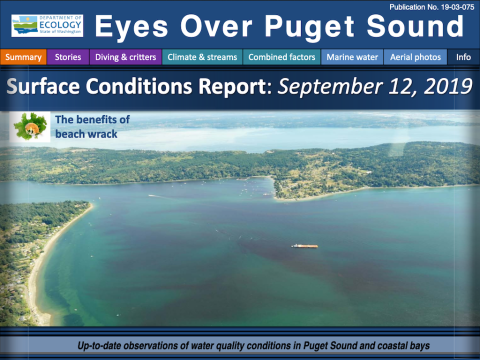
Air temperatures have remained high with precipitation and river flows below normal, extending the summer’s unusual conditions. Water temperatures were warmer in August, perhaps too warm for bull kelp and some salmon species in South Sound. In contrast, Hood Canal, North Sound, and the San Juan Islands provide optimal growth temperatures for herring and salmon. Many terminal inlets of Puget Sound are experiencing extensive red-brown blooms. Jellyfish patches are developing in South Sound finger Inlets and remnants of floating macroalgae occur in the nearshore areas of South Sound and in Useless Bay. At times floating organic material we see from the air ends up on the shoreline were our BEACH team documents it.