Monitoring

Monitoring encompasses the routine measurement of ecosystem indicators to assess the status and trends of ecosystem structure and function. Broadly, there are two goals for monitoring in the Puget Sound ecosystem. The first goal is to monitor status and trends of the ecosystem. This may take the form of snapshots of specific regions, or, more usefully, status monitoring tracks variability in carefully selected indicators over time. Status monitoring is fundamentally concerned with documenting spatial and temporal variability in ecosystem components and thus ideally relies on consistent long-term monitoring in a network of sites. A second aim of monitoring is to evaluate the effectiveness of management strategies. Effectiveness monitoring thus aims to detect changes in ecosystem status that are caused by specific management actions.

Sources:

Puget Sound Science Review

Additional resources:

Puget Sound Ecosystem Monitoring Program

Eyes Over Puget Sound

Overview

The Puget Sound Ecosystem Monitoring Program (PSEMP) is an independent program established by state and federal statute to monitor environmental conditions in Puget Sound. 

PSEMP logo

Related Articles

The Puget Sound Ecosystem Monitoring Program has released its sixth annual Marine Waters Overview. The report provides an assessment of marine conditions for the year 2016 and includes updates on water quality as well as status reports for select plankton, seabirds and fish.

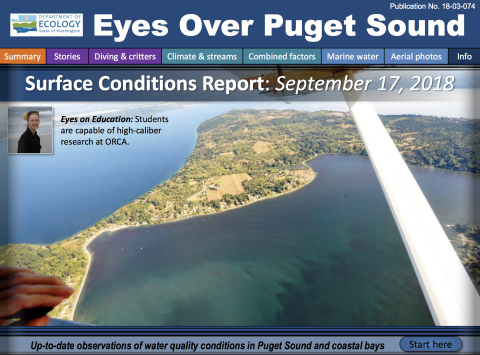
After a dry and sunny summer extending well into October, air temperatures are cooler than normal and precipitation has increased allowing rivers to regain strength. Despite a dry summer, Puget Sound is fresher this year than the past 17 years. As of September, warmer temperatures remained in South Sound. In October, surface water in the Straits however began to cool and the influence of rivers can be seen in our ferry data. Leaves drift on the water in South Sound and smaller blooms are confined to inlets as the productive season winds down. Meet our new intern and discover if Puget Sound really has sea spiders.

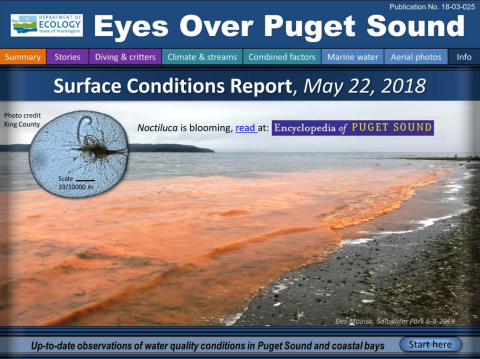
Warm air temperatures, abundant sunshine, and drier conditions persisted. River flows are lower in the north. Puget Sound waters are still fresher than in the past 17 years from the combination of abundant spring rain and weak upwelling bringing less salty water from the ocean. July upwelling was stronger, however. Warmer water temperatures are notable in parts of Central Sound, accompanied by large rafts of drifting macroalgae. Diverse blooms in colors of green, orange and red-brown are present in many inlets. Jellyfish abundance is lower this year. Find out how we assess if the benthos is changing.

A new study shows a surprising decline in some toxic chemicals in Puget Sound fish, while levels of PCBs increased in some cases. Scientists say the study shows that banning toxic chemicals can work, but old contaminants remain a challenge as they continue to wash into Puget Sound.

Toxic chemicals have been showing up in Puget Sound fish for more than a century, but consistent testing over the past 30 years has helped to reveal some unusual patterns of pollution.

In recent decades, hundreds of millions of dollars have been spent to restore habitat for Puget Sound salmon. In this article, we look at how scientists are gauging their progress. Are environmental conditions improving or getting worse? The answer may depend on where you look and who you ask.