The Washington State Department of Ecology is responding to new legal rulings and public concerns with changes in planning and potentially future enforcement. We continue our occasional series on water quality and wastewater management in Puget Sound. Funding for the series is provided in part by King County.
Scientists at the Washington Department of Ecology along with many other researchers have spent years studying and debating the problem of low oxygen in Puget Sound. Now, many new developments — technical, scientific and legal — are reaching a critical stage and setting up a framework to make some major decisions. This is part four of a four-part series originally published in the Puget Sound Institute blog.
Scientists at the Washington Department of Ecology along with many other researchers have spent years studying and debating the problem of low oxygen in Puget Sound. Now, many new developments — technical, scientific and legal — are reaching a critical stage and setting up a framework to make some major decisions. This is part three of a four-part series originally published in the Puget Sound Institute blog.
Scientists at the Washington Department of Ecology along with many other researchers have spent years studying and debating the problem of low oxygen in Puget Sound. Now, many new developments — technical, scientific and legal — are reaching a critical stage and setting up a framework to make some major decisions. This is part two of a four-part series originally published in the Puget Sound Institute blog.
Scientists at the Washington Department of Ecology along with many other researchers have spent years studying and debating the problem of low oxygen in Puget Sound. Now, many new developments — technical, scientific and legal — are reaching a critical stage and setting up a framework to make some major decisions. This four-part series was originally published in the Puget Sound Institute blog and looks back on how we have reached our present condition, including a consideration of possible solutions. Subsequent parts of the series are available through a link at the conclusion of this article.
About 83% of the water in Puget Sound comes from the ocean. That brings with it all kinds of benefits, including an ocean-size amount of life-giving nutrients that feed the creatures that live here. But it has one potential drawback. That ocean water is notoriously low in oxygen. Why is that and what does it mean for the future of Puget Sound?
A new study outlines the strong link between dissolved oxygen declines and increasing water temperatures, raising questions about the effect of future climate change on Puget Sound.
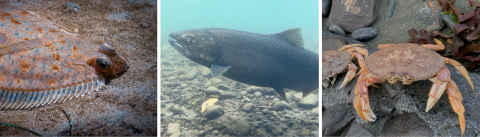
There is an ongoing concern that human activities can cause reductions in the amount of oxygen available to fish and other marine species. In Puget Sound, scientists are working to evaluate when and where some of these reductions could have an adverse ecological impact. As part of a series of workshops on Puget Sound water quality, the Puget Sound Institute asked Dr. Tim Essington of the University of Washington School of Aquatic and Fishery Sciences to describe how low dissolved oxygen affects species like salmon or Dungeness crabs. The following text is adapted from a video presentation by Essington in 2023.
Low dissolved oxygen levels put aquatic life in Puget Sound at risk – but not everywhere. A combination of careful monitoring efforts and powerful computer models are now enabling scientists to identify which areas of our regional waters are most prone to low oxygen levels, when, and why. This article is part of a series of reports funded by King County about the quest to define healthy oxygen levels in Puget Sound.