


The oxygen content of the ocean water that eventually makes its way into Puget Sound is generally not so meager as to pose a problem for marine life. However, it sets a low baseline level of oxygen that can make Puget Sound more vulnerable to algal blooms and other oxygen-depleting mechanisms. The low level of oxygen in ocean water entering Puget Sound is due to several factors – some of which are being accentuated by climate change.
First, Puget Sound is about 83% seawater, fed by a massive subsurface flow roughly the size of the Amazon River that moves trillions of gallons of water from the Pacific Ocean through the Strait of Juan de Fuca. In contrast, many other estuaries such as the Chesapeake Bay get most of their water from rivers and streams.
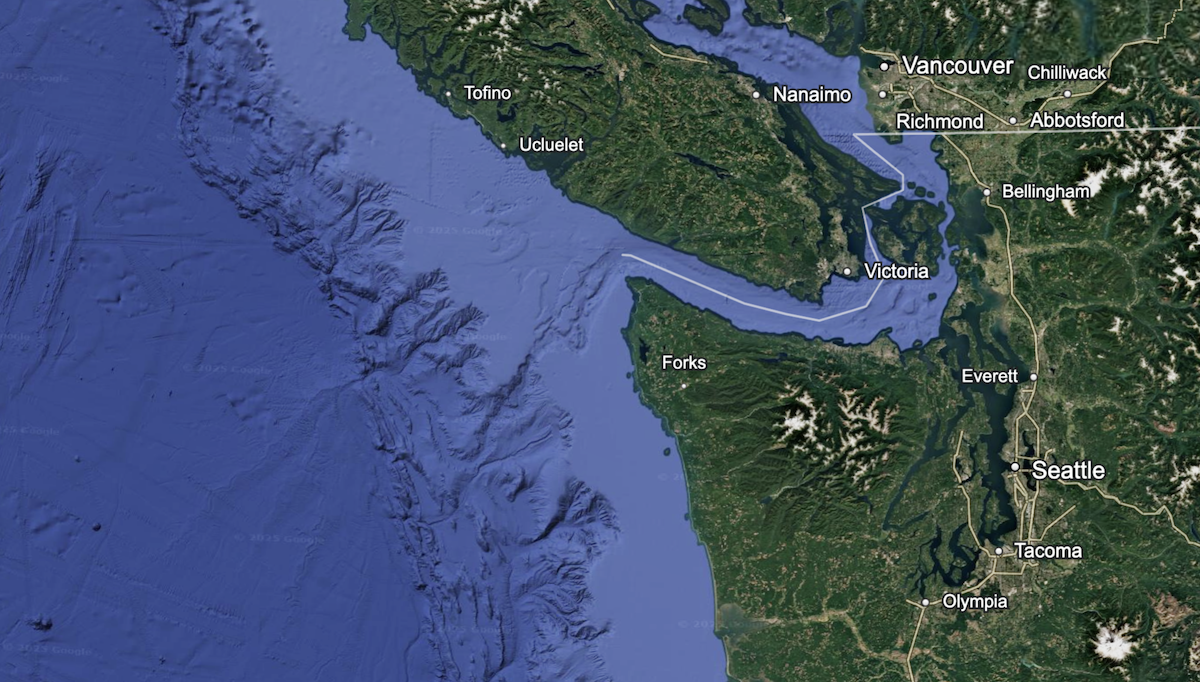
In addition, that seawater comes in deep, says University of Washington oceanographer Parker MacCready. The Strait of Juan de Fuca is about 200 meters deep at its western entrance. And deeper water is lower in oxygen than surface waters, where constant interchange of gases with the atmosphere results in water that is saturated with oxygen. “As you go down in the water, the oxygen gets lower and lower,” MacCready says.
Both the high proportion of seawater in Puget Sound and the deep entrance to the Strait of Juan de Fuca reflect the system’s glacial history. This sets Puget Sound apart since glacier-carved, fjord-like estuaries are rare at middle latitudes.
Moreover, the deep waters of the northeast Pacific tend to be especially low in oxygen because global ocean circulation patterns have kept these water masses isolated from the surface for decades. Over time, particles of dead organic matter drift down from the surface and are decomposed by bacteria, a process that depletes oxygen in these “old” deep waters.
Deep ocean waters have also been getting lower in oxygen over the past several decades, due to a number of processes linked to climate change.
Low oxygen levels in ocean waters entering Puget Sound, then, are “a consequence of us being connected to the deep ocean and, moreover, being connected to this part of the ocean where the incoming water has really high nutrients and relatively low oxygen,” MacCready explains.
This effect is magnified by the Juan de Fuca Canyon, a massive submarine gorge at the edge of the continental shelf outside the entrance to the Strait of Juan de Fuca. The canyon is 50 to 300 meters deeper than the surrounding continental shelf and just 6 kilometers wide, sluicing deep water into the strait at a rate of 150,000 cubic meters of water per second.
Most of the water that enters Puget Sound originates from the California Undercurrent, a subsurface flow that begins around Mexico and hugs the coast as it travels northwards. The California Undercurrent flows about 125-325 meters below the surface off the coast of Washington and has oxygen levels about 30% of atmospheric saturation.
The influence of deep ocean waters is especially prominent during periods of upwelling, which is prevalent from April through September in the Pacific Northwest. Winds blowing from the North move surface waters westward, away from shore, due to the Coriolis effect. This draws deeper waters up toward the surface.
When these nutrient-rich deep waters reach the photic zone near the surface, they stimulate blooms of phytoplankton along the continental shelf. As the blooms die back, sink, and are decomposed by bacteria, oxygen levels in near-bottom waters are depleted. “So now the low-oxygen water is even lower in oxygen, says Jack Barth, an oceanographer at Oregon State University in Corvallis. “The picture is this ribbon [of upwelled water] along the coast, poised to enter the estuaries,” including Puget Sound.
Climate change is accentuating these upwelling-related dynamics, Barth and his collaborators found in an analysis published last year. During an extremely strong (but increasingly common) upwelling season in 2021, about half the continental shelf bottom waters off the Pacific Northwest coast were hypoxic – compared to just 2% in 1950-1980 and 24% from 2009-2018.
In the past, frequent changes in wind direction due to a wobbling jet stream led to a mix of upwelling and downwelling conditions during the summer that kept ocean waters better oxygenated. But lately, warming temperatures and an increased difference between land and sea temperatures have produced more consistent northerly winds and more persistent, stronger upwelling conditions.
Larger hypoxic zones on the continental shelf, then, may set an even lower oxygen baseline for water entering the Salish Sea. This is not the end of the story: As deep water from the Pacific Ocean moves inland, it encounters strong tidal currents, submerged sills that demarcate the different basins of Puget Sound, and an intricate, fractal like coastline of islands and headlands. All these features churn up the water, sometimes described as being like a series of giant eggbeaters, mixing different layers to distribute oxygen more evenly throughout the water column.
Still, the bigger picture remains. "Things that happen locally, whether it be at my little Yaquina Bay Estuary or Puget Sound, are connected to the whole North Pacific through these circulation patterns,” Barth says. Local inputs like agricultural runoff and nutrients from wastewater treatment plants require attention, “but we're also changing patterns on this 10,000-kilometer-scale ocean basin."
This article was funded in part by King County in conjunction with a series of online workshops exploring Puget Sound water quality. Its content does not necessarily represent the views of King County or its employees.