Salmonids

Fish in the family Salmonidae (salmon, trout, and charr) are unique in their cultural, economic and ecological role in Puget Sound. Because they utilize a very wide range of aquatic habitat types throughout their life history, they play potentially integral roles in the upland freshwater, nearshore and pelagic marine ecosystems and food webs of Puget Sound. They also provide key trophic links between habitats through their migratory behavior. While there is much variation in the behavior and ecology within and among the different salmonid species in Puget Sound, they typically use freshwater habitats to spawn, after which juveniles emerge and eventually migrate to nearshore estuaries or directly to marine pelagic habitats. The watersheds and nearshore habitats of Puget Sound currently support 8 species of salmon, trout, and charr (NOAA 2007), four of which are listed as Threatened under the Endangered Species Act (ESA). These are Chinook salmon (Oncorhynchus tshawytscha), chum salmon (O. keta), bull trout (Salvelinus confluentus) and steelhead (O. mykiss).

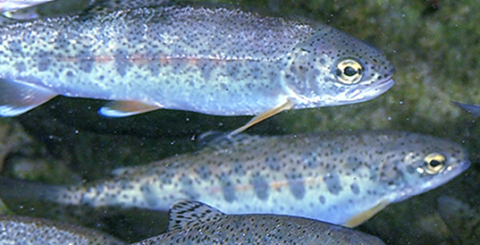
Puget Sound salmon:

Chinook salmon (Oncorhynchus tshawytscha)

Chum salmon (Oncorhynchus keta)

Sockeye salmon (Oncorhynchus nerka)

Pink salmon (Oncorhynchus gorbuscha)

Coho salmon (Oncorhynchus kisutch)

Puget Sound trout

Steelhead (Oncorhynchus mykiss)

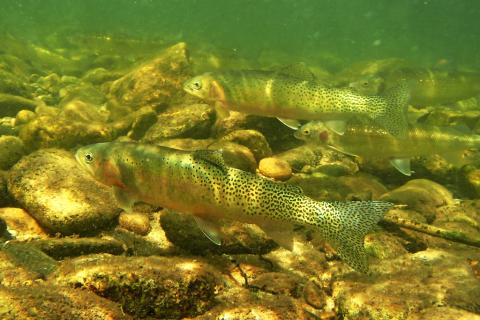
Cutthroat trout (Oncorhynchus clarki clarki)

Puget Sound charr

Bull trout (Salvelinus confluentus

-- Source: Puget Sound Science Review

Overview

Fish in the family Salmonidae (salmon, trout, and charr) play potentially integral roles in the upland freshwater, nearshore and pelagic marine ecosystems and food webs of Puget Sound.

Chum salmon (Oncorhynchus keta). Image courtesy U.S. Fish and Wildlife Service.

Related Articles

This three-part series explores opportunities and challenges of using medical interventions to save Puget Sound's southern resident orcas from extinction. Part 1 looks at how scientists might treat endangered southern resident orcas that face starvation and risks of disease; Part 2 considers how veterinarians have intervened with other animals in the wild, and how this might apply to orcas in Puget Sound; and Part 3 explores a federally approved vaccination program designed to ward of a deadly virus among endangered Hawaiian monk seals.

The death of a young female orca in September has sparked a discussion of how and whether scientists should step in with medical care for distressed animals in the wild. Medical intervention has become routine for some endangered mammals, but scientists say Puget Sound’s resident orcas present a series of unique challenges and ethical questions. In part one of our two-part series The Orca Docs we look at how scientists are preparing to treat endangered southern resident orcas that face starvation and risks of disease.

Can scientists bring back the lost tidal forests of Puget Sound? It could take generations, but restoring this rare habitat will pay big dividends for Puget Sound’s salmon.   

An intensive research program in the U.S. and Canada is studying why so few salmon in the Salish Sea are returning home to spawn. It is uncovering a complex web of problems involving predators, prey and other factors that put salmon at risk as they migrate to the ocean. We present a four-part series on the Salish Sea Marine Survival Project, including new findings presented at the 2018 Salish Sea Ecosystem Conference last spring in Seattle.

Chemicals, disease and other stressors can increase a salmon's chance of being eaten or reduce its ability to catch food. We wrap up our series on the Salish Sea Marine Survival Project with a look at some of the lesser-known, but still significant factors contributing to salmon declines in the Salish Sea.

A recent influx of anchovies into Puget Sound may have saved some steelhead from predators, but researchers seek more evidence to prove the connection. Our series on the Salish Sea Marine Survival Project continues with a look at these and other potential impacts from predators on the region's salmon and steelhead.