Salmonids

Fish in the family Salmonidae (salmon, trout, and charr) are unique in their cultural, economic and ecological role in Puget Sound. Because they utilize a very wide range of aquatic habitat types throughout their life history, they play potentially integral roles in the upland freshwater, nearshore and pelagic marine ecosystems and food webs of Puget Sound. They also provide key trophic links between habitats through their migratory behavior. While there is much variation in the behavior and ecology within and among the different salmonid species in Puget Sound, they typically use freshwater habitats to spawn, after which juveniles emerge and eventually migrate to nearshore estuaries or directly to marine pelagic habitats. The watersheds and nearshore habitats of Puget Sound currently support 8 species of salmon, trout, and charr (NOAA 2007), four of which are listed as Threatened under the Endangered Species Act (ESA). These are Chinook salmon (Oncorhynchus tshawytscha), chum salmon (O. keta), bull trout (Salvelinus confluentus) and steelhead (O. mykiss).

Puget Sound salmon:

Chinook salmon (Oncorhynchus tshawytscha)

Chum salmon (Oncorhynchus keta)

Sockeye salmon (Oncorhynchus nerka)

Pink salmon (Oncorhynchus gorbuscha)

Coho salmon (Oncorhynchus kisutch)

Puget Sound trout

Steelhead (Oncorhynchus mykiss)

Cutthroat trout (Oncorhynchus clarki clarki)

Puget Sound charr

Bull trout (Salvelinus confluentus

-- Source: Puget Sound Science Review

Overview

Fish in the family Salmonidae (salmon, trout, and charr) play potentially integral roles in the upland freshwater, nearshore and pelagic marine ecosystems and food webs of Puget Sound.

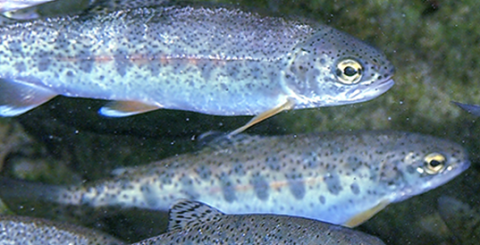
Chum salmon (Oncorhynchus keta). Image courtesy U.S. Fish and Wildlife Service.

Related Articles

A new approach to flood control is taking hold across Puget Sound. Rivers, scientists say, can be contained by setting them free. Conservationists hope this is good news for salmon recovery.

As threatened Chinook populations in Puget Sound continue to lose ground, the state is looking to new strategies to reverse the trend. In the Skagit watershed, the scientists — and the fish — are among those leading the way. 

A new study shows that increased populations of seals and sea lions are eating far more of Puget Sound’s threatened chinook than previously known, potentially hampering recovery efforts for both salmon and endangered killer whales. 

The Puget Sound Ecosystem Monitoring Program released its fifth annual Marine Waters Overview this week. The report provides an assessment of marine conditions for the year 2015 and includes updates on water quality as well as status reports for select plankton, seabirds, fish and marine mammals.

New techniques for studying orcas have been credited with breakthroughs in reproductive and developmental research. Drones and hormone-sniffing dogs are helping scientists connect declines in food supply with low birth rates and poor health. Update: The research described in this 2016 article has now been published in the 6/29/17 issue of the journal PLOS ONE.

New, smaller acoustic tags will allow scientists to track steelhead migrations in Puget Sound in ways that were once impossible. Will they provide answers to the mysterious decline of these now-threatened fish?