The state of Washington estimates that the Puget Sound area will grow by more than 1.5 million residents within the next two decades. That is expected to have profound effects on the environment as more and more people move to undeveloped areas. The race is on to protect this critical rural habitat, but planners say what happens in the cities may be just as important.
A new approach to flood control is taking hold across Puget Sound. Rivers, scientists say, can be contained by setting them free. Conservationists hope this is good news for salmon recovery.
As threatened Chinook populations in Puget Sound continue to lose ground, the state is looking to new strategies to reverse the trend. In the Skagit watershed, the scientists — and the fish — are among those leading the way.
After a long struggle with pollution, Drayton Harbor has reopened to year-round commercial oyster harvesting for the first time in 22 years. Here’s how the community cleaned up its act, potentially showing the way for shellfish recovery throughout Puget Sound.
A new study shows that increased populations of seals and sea lions are eating far more of Puget Sound’s threatened chinook than previously known, potentially hampering recovery efforts for both salmon and endangered killer whales.
Many groups have been formed around the goal of saving salmon, but few people talk about a concerted effort to save microscopic creatures. Whether or not a pro-bug movement catches on, future strategies to save salmon are likely to incorporate ideas for restoring streambound creatures known as benthic invertebrates.
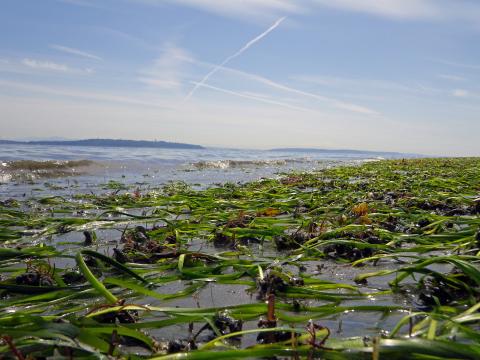
Eelgrass, a marine plant crucial to the success of migrating juvenile salmon and spawning Pacific herring, is stable and flourishing in Puget Sound, despite a doubling of the region’s human population and significant shoreline development over the past several decades. [Story reprinted from UW Today.]
New EPA-funded Implementation Strategies are designed to target Puget Sound recovery in the most direct and coordinated way ever conducted by state and federal agencies. We report on how these strategies will affect Puget Sound’s Vital Signs for years to come, and why you should care (a lot).
Drugs like Prozac and cocaine have been showing up in the region’s salmon. But these are just some of the potentially thousands of different man-made chemicals that escape into the Salish Sea every day, from pharmaceuticals to industrial compounds. Now the race is on to identify which ones pose the greatest dangers.
New federal legislation, approved overwhelmingly by the U.S. Congress in December 2015 and signed into law by President Obama in June 2016, is designed to make sure that people and the environment are not harmed by new and old chemicals on the market.