

All Articles
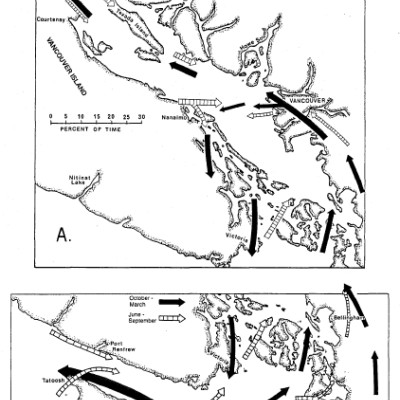
Review of the marine environment and biota of Strait of Georgia, Puget Sound and Juan de Fuca Strait
Proceedings of the BC/Washington Symposium on the Marine Environment, January 13 and 14, 1994
Conservation and ecology of marine forage fishes— Proceedings of a research symposium, September 2012
The symposium was held on September 12–14, 2012, at the University of Washington, Friday Harbor Laboratories campus. Sixty scientists, graduate students, and fisheries policy experts convened; showcasing ongoing research, conservation, and management efforts targeting forage fish from regional and national perspectives.
Geographical distribution of Puget Sound fishes: maps and data source sheets
A study of the nutrients in the main basin of Puget Sound
This study compared recent and historical data to determine the presence of any significant changes in nutrient and oxygen concentrations subsequent to METRO discharge, examined seasonal cycles in water properties, and examined the flux of nutrients within the study area.
Eyes Over Puget Sound: Surface Conditions Report – August 4, 2015
Unusually warm water temperatures continue in central and south Puget Sound. River flows remain lower than normal, especially the Fraser and Skagit rivers. Thus, with estuarine circulation much weaker, Puget Sound waters stay put. Mats of organic debris persist in Central Sound near Port Madison. Red-brown and brown blooms are now very strong in southern inlets and jellyfish patches are
The temperature and salinity characteristics of Puget Sound and Strait of Juan de Fuca based on the M. V. CATALYST observations of 1932 to 1942
A 1956 thesis submitted in partial fulfillment ot the requirement for degree of Master of Science, University of Washington
Chemistry of Puget Sound waters and influencing factors
This 1954 report present the results of a geochemical investigation, based on existing data, of the waters of Puget Sound. Rivers draining into the Puget Sound and upwelled water moving in at depth from Juan de Fuca Strait are the chief sources of the chemical constituents in Puget Sound.
The surface winds over Puget Sound and the Strait of Juan de Fuca and their oceanographic effects
This 1954 report accumulates all available wind report summaries have been in the form of monthly wind roses for each reporting station and makes a determination of the frequency and maximum duration of surface winds of above average velocity at selected stations over a three year period.
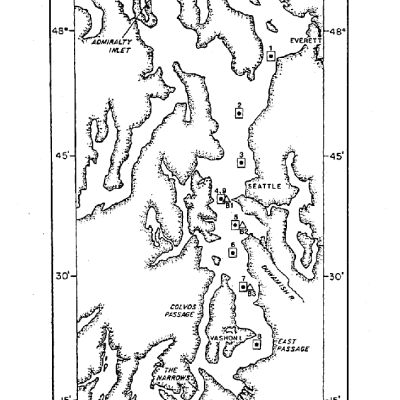
Presence, distribution and fate of toxicants in Puget Sound and Lake Washington
Toxicant pretreatment planning study technical report C1: Presence, distribution and fate of toxicants in Puget Sound and Lake Washington was published in October 1984.
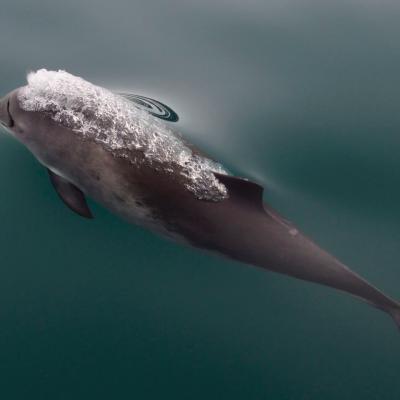
Increased harbor porpoise mortality in the Pacific Northwest, USA: understanding when higher levels may be normal
A 2015 paper in the journal Diseases of Aquatic Organisms examines potential causes of increased harbor porpoise strandings in Washington and Oregon.