Marine habitat

The Marine System encompasses all coastal areas not appreciably diluted by freshwater (surface salinities seldom falling below 30 ppt), including open coastal areas, straits, and euhaline inland waters.  It can extend from the outer edge of the continental shelf to (1) the landward limit of tidal inundation or wave splash or (2) the seaward limit of the Estuarine System.

Source:

Dethier, M.N. 1990. A marine and estuarine habitat classification system for Washington State. Natural Heritage Program, WA DNR, Olympia, WA. 60 pp.

Overview

Each year, the Puget Sound Ecosystem Monitoring Program releases the annual Puget Sound Marine Waters Overview report. The latest report combines a wealth of data from comprehensive monitoring programs and provides a concise summary of what was happening in Puget Sound’s marine waters during 2022. The report represents the collective effort of 84 contributors from federal, tribal, state, and local agencies, academia, nonprofits, and private and volunteer groups.

Image of a sailboat on the water at sunset.Text overlay reads: Puget Sound Marind Waters 2022 Overview.

Related Articles

Concerns over the potential arrival of the European green crab have inspired a small army of volunteers. A search is underway for early signs of an invasion.

Almost twenty years ago, volunteer biologists began an intensive survey for invasive species in the marine waters of Puget Sound. In a little over a week of hunting, they found 39 such species, including 11 never before seen in the region.

The Washington Invasive Species Council evaluated more than 700 invasive species in and around Washington, considering their threats to the state’s environment, economy, and human health. They included terrestrial plants and animals, aquatic plants and animals (both freshwater and saltwater), insects and diseases. In the end, the council listed 50 “priority species” for action, including five marine animals and two marine plants, along with one virus that infects fish. 

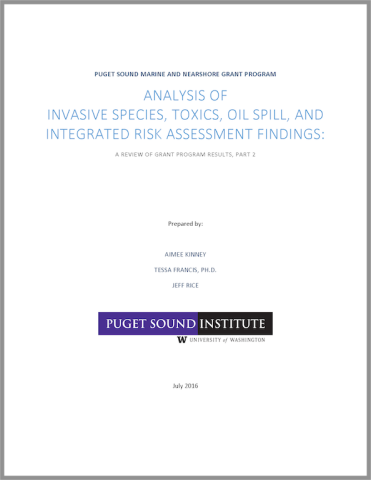
A July 2016 report from the University of Washington Puget Sound Institute summarizes and reviews 10 EPA-funded projects focusing on Puget Sound's marine and nearshore environments. The projects were conducted between 2011-2015 with support from the EPA's National Estuary Program.  The report is an analysis of findings on invasive species, toxics, oil spill, and integrated risk assessment.

Formerly known as “Red Tide”, harmful algal blooms are a health concern for both wildlife and humans. The following is a brief review of some of these algae and their effects.

New techniques for studying orcas have been credited with breakthroughs in reproductive and developmental research. Drones and hormone-sniffing dogs are helping scientists connect declines in food supply with low birth rates and poor health. Update: The research described in this 2016 article has now been published in the 6/29/17 issue of the journal PLOS ONE.