Nearshore habitat

The nearshore habitat of Puget Sound is usually defined as the area from the bluffs that line the shore to the area where water becomes too deep for light to penetrate and allow plants to grow, measured relative to mean lower low water (MLLW). It includes marine habitat and estuarine habitat, but stops at the farthest reach of the tide into an estuary, or the point where saltwater no longer mixes with fresh. Within Puget Sound’s nearshore are many varied habitat types, including rocky and sandy beaches, mudflats, salt marshes, kelp and eelgrass beds, and lagoons.

Sources:

Puget Sound Nearshore Ecosystem Restoration Project: http://www.pugetsoundnearshore.org/technical_reports.html.

Overview

The Puget Sound Nearshore Ecosystem Restoration Project (PSNERP) works to assess the health of Puget Sound nearshore environments and provides strategies for their protection and restoration. 

PSNERP logo

Related Articles

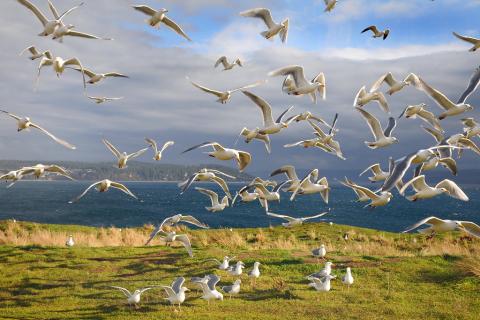
An unintended consequence of the recovery of bald eagles (Haliaeetus leucocephalus) has been the impact on seabirds. The authors of a 2019 paper published in Ecology and Evolution suggest that the effects of bald eagle activity on a large glaucous-winged gull (Larus glaucescens) colony on Protection Island in the Strait of Juan de Fuca include the possibility of coexistence but also the possibility of gull colony extinction.

The Washington Department of Natural Resources is studying new ways of increasing ecologically important eelgrass habitat in Puget Sound. It is part of the state's effort to boost eelgrass 20% Sound-wide by 2020. So far, recovery of the species has fallen short of that goal, but transplanting efforts are showing promise. 

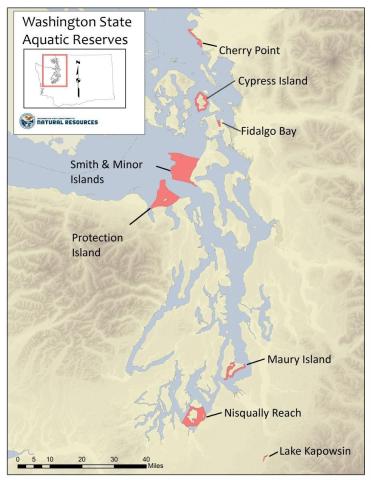
Eight aquatic reserves in Puget Sound are being studied by volunteers working under the direction of state experts. Washington Department of Natural Resources manages the reserves with guidance from nearby communities.

Eight aquatic reserves, managed by the Washington Department of Natural Resources, have been established to protect important ecosystems on state aquatic lands.

In most reserves, area residents work with state, local and tribal officials and nonprofit groups to develop and carry out management plans, including scientific research.

The aquatic reserves in the order they were established include: 

  • Maury Island 2004
  • Cypress Island  2007
  • Fidalgo Bay 2008
  • Cherry Point 2010
  • Protection Island 2010
  • Smith and Minor Islands 2010
  • Nisqually Reach 2011
  • Lake Kapowsin 2016

Each winter and spring, researchers survey the sometimes spectacular spawning events of Puget Sound's Pacific herring. They have found wide swings in the fish's population and an overall decline in herring numbers since the 1970s, but little is known about the cause or what this might mean for the health of the food web. We spent a day with a biologist spotting herring eggs and considering the future of one of our region's most ecologically and culturally important fish species. 

The removal of shoreline armoring has become a priority for the state's Puget Sound recovery efforts. The Puget Sound Ecosystem Monitoring Program (PSEMP) is providing details on the effectiveness of armor-removal projects at 49 study sites.