Killer whales

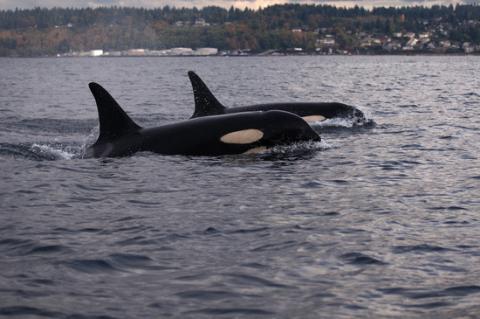
Killer whales are distributed throughout the marine waters of Washington. Four populations are recognized and are referred to as southern residents, northern residents, transients, and offshores. Among these, southern resident and transient (also known as Bigg's) killer whales commonly are found in Puget Sound. 

--Source: Puget Sound Science Update.

Overview

Three distinct groups of killer whales (Orcinus orca) occupy the coastal waters of the northeastern Pacific. These groups—northern and southern residents, transients, and offshores—are distinguished by diet, behavior, morphology, and other characteristics. Among these, southern resident and transient killer whales commonly are found in Puget Sound. Northern residents and offshore killer whales rarely enter Puget Sound (Wiles 2004, Kriete 2007), and therefore are not described in detail here.

Killer whale (Orcinus orca). Photo courtesy of NOAA.

Related Articles

Last month's federal authorization to kill more than 700 sea lions to protect salmon runs along the Columbia River is prompting discussions of similar actions for harbor seals in Puget Sound. But experts say the situations are very different with many unanswered questions. 

The Salish Sea’s endangered southern resident orcas travel freely across the U.S.-Canada border, unconstrained by political boundaries. But while they don’t require passports, they can still face differing policies and conditions as they go back and forth between nations. We look at some of the ways that the United States and Canada compare in their efforts to protect the whales.

A 2020 paper published in Frontiers in Marine Science describes details of the fungal disease Mucormycosis which has caused the death of harbor porpoises, harbor seals and one orca in Puget Sound in recent years. The authors discuss the implications for local marine mammals, specifically the endangered southern resident killer whale population.

Social scientists at Oregon State University have been analyzing a trove of more than 17,000 public comments sent to the Washington state governor's southern resident orca recovery task force. The researchers have added the comments to a keyword database to look at public emotions and perceptions around the issue of orca declines.

Researchers studying the killer whales that frequent Puget Sound are growing increasingly concerned that a dangerous virus or other disease-causing organism could spread through the population and hasten extinction of these critically endangered southern resident orcas.

Officially known as West Coast transients but increasingly referred to as Bigg’s killer whales, these marine mammal-eating orcas (Orcinus orca) are spending increasing time in the Salish Sea to consume their marine mammal prey including harbor seals, Steller sea lions, and harbor and Dall’s porpoise. They range from Southeast Alaska to California, but over the last 15 years more members of the population are spending increasing time in the inland waters of Washington State and British Columbia (Houghton et al. 2015, Shields et al. 2018). They have no predators (except perhaps occasionally other Bigg’s killer whales - see Towers et al. 2018), but are at risk from anthropogenic effects, including toxics and noise pollution (Ford et al. 2007).