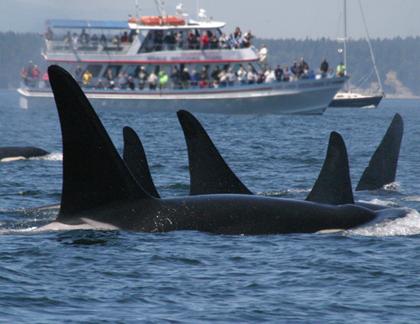
Killer whales

Killer whales are distributed throughout the marine waters of Washington. Four populations are recognized and are referred to as southern residents, northern residents, transients, and offshores. Among these, southern resident and transient (also known as Bigg's) killer whales commonly are found in Puget Sound. 

--Source: Puget Sound Science Update.

Overview

Three distinct groups of killer whales (Orcinus orca) occupy the coastal waters of the northeastern Pacific. These groups—northern and southern residents, transients, and offshores—are distinguished by diet, behavior, morphology, and other characteristics. Among these, southern resident and transient killer whales commonly are found in Puget Sound. Northern residents and offshore killer whales rarely enter Puget Sound (Wiles 2004, Kriete 2007), and therefore are not described in detail here.

Killer whale (Orcinus orca). Photo courtesy of NOAA.

Related Articles

A December 2017 article in the journal PLOS One reports that incidents and violations among whale watching vessels have increased in the Central Salish Sea since 1998.

Increased consumption of Chinook salmon by seals and sea lions in the Salish Sea “could be masking the success of coastwide salmon recovery efforts,” according to a new study published in the journal Scientific Reports. Endangered resident orcas are said to be declining in part due to a lack of available Chinook, the orcas' preferred prey.

A 2017 report from the Puget Sound Ecosystem Monitoring Program presents an overview of selected recent monitoring and research activities focused on toxic contaminants in the Salish Sea. 

The Puget Sound Ecosystem Monitoring Program (PSEMP) is an independent program established by state and federal statute to monitor environmental conditions in Puget Sound. 

A new study shows that increased populations of seals and sea lions are eating far more of Puget Sound’s threatened chinook than previously known, potentially hampering recovery efforts for both salmon and endangered killer whales. 

New techniques for studying orcas have been credited with breakthroughs in reproductive and developmental research. Drones and hormone-sniffing dogs are helping scientists connect declines in food supply with low birth rates and poor health. Update: The research described in this 2016 article has now been published in the 6/29/17 issue of the journal PLOS ONE.