Killer whales

Killer whales are distributed throughout the marine waters of Washington. Four populations are recognized and are referred to as southern residents, northern residents, transients, and offshores. Among these, southern resident and transient (also known as Bigg's) killer whales commonly are found in Puget Sound. 

--Source: Puget Sound Science Update.

Overview

Three distinct groups of killer whales (Orcinus orca) occupy the coastal waters of the northeastern Pacific. These groups—northern and southern residents, transients, and offshores—are distinguished by diet, behavior, morphology, and other characteristics. Among these, southern resident and transient killer whales commonly are found in Puget Sound. Northern residents and offshore killer whales rarely enter Puget Sound (Wiles 2004, Kriete 2007), and therefore are not described in detail here.

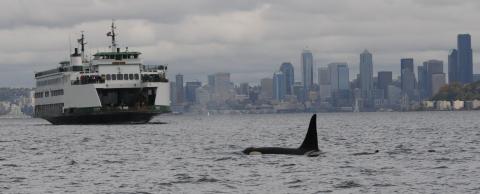
Killer whale (Orcinus orca). Photo courtesy of NOAA.

Related Articles

Research on the sounds and feeding behavior of Puget Sound's southern resident orcas is providing new insight into how the whales respond to underwater noise. A recent online conference brought together some of these findings along with discussions on how to reduce the impacts of noise from vessel traffic.

The tenth annual Puget Sound Marine Waters Overview looks at marine water quality and other conditions in the region in 2020. According to the report, there were few extreme weather or ecological events in 2020, but overall, conditions in Puget Sound were generally warmer, sunnier, and wetter than in typical years. The overview also examines patterns and trends in numerous environmental parameters, including plankton, water quality, climate, and marine life. 

A 2021 paper in the journal PLoS ONE provides a clearer picture of what endangered southern resident orcas eat throughout the year. Chinook salmon make up the bulk of the whales' diet, but the paper suggests that other salmon species and non-salmonid fishes can also play important roles depending on the season.

Collisions with boats and other interactions with humans are "significant" causes of death for killer whales in the northeastern Pacific, a recent study says. The findings come from one of the most comprehensive looks at killer whale pathology to date, but scientists say determining how a killer whale may have died is often notoriously difficult.

A 2020 study of pathology reports for 53 stranded killer whales in the northeastern Pacific and Hawaii showed that deaths related to human interaction were found in every age class. Vessel strikes accounted for the deaths of four of the nine endangered southern resident killer whales identified in the study. The findings were published Dec. 2 in the journal PLOS ONE.

A new report from the Puget Sound Ecosystem Monitoring Program details the effects of a changing climate on Puget Sound in 2019, and documents how these changes moved through the ecosystem to affect marine life and seafood consumers.