Killer whales

Killer whales are distributed throughout the marine waters of Washington. Four populations are recognized and are referred to as southern residents, northern residents, transients, and offshores. Among these, southern resident and transient (also known as Bigg's) killer whales commonly are found in Puget Sound. 

--Source: Puget Sound Science Update.

Overview

Three distinct groups of killer whales (Orcinus orca) occupy the coastal waters of the northeastern Pacific. These groups—northern and southern residents, transients, and offshores—are distinguished by diet, behavior, morphology, and other characteristics. Among these, southern resident and transient killer whales commonly are found in Puget Sound. Northern residents and offshore killer whales rarely enter Puget Sound (Wiles 2004, Kriete 2007), and therefore are not described in detail here.

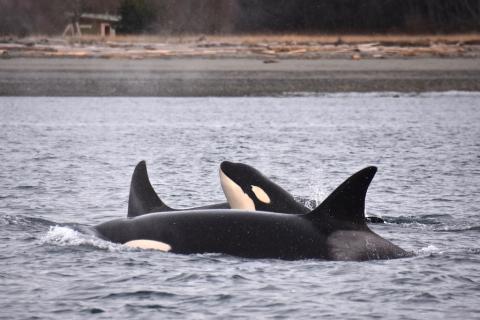
Killer whale (Orcinus orca). Photo courtesy of NOAA.

Related Articles

As the plight of Puget Sound’s southern resident orcas becomes increasingly desperate, with the population dropping from 98 to 75 in just 22 years, scientists are weighing the options of medical intervention. In part two of our two-part series The Orca Docs we look at how veterinarians have intervened with other animals in the wild, and how this might apply to the situation here in Puget Sound. [Part one, "When should medical experts intervene to save a killer whale?" is also available.]

The death of a young female orca in September has sparked a discussion of how and whether scientists should step in with medical care for distressed animals in the wild. Medical intervention has become routine for some endangered mammals, but scientists say Puget Sound’s resident orcas present a series of unique challenges and ethical questions. In part one of our two-part series The Orca Docs we look at how scientists are preparing to treat endangered southern resident orcas that face starvation and risks of disease.

A 2018 paper in the journal Endangered Species Research analyzes southern resident killer whale sightings in the Salish Sea between 1976 and 2014. 

Between 1962 and 1973, at least 263 killer whales were caught or killed in the waters of British Columbia and Washington (Bigg and Wolman 1975). Twelve of these died during capture and fifty were kept for display in aquariums. The remainder of the captured animals escaped or were released. Twenty-seven of the whales kept as captive were taken from the population now designated as endangered southern-resident killer whales (Balcomb 2018). Of those captive whales, all but one have since died. The sole living whale, nicknamed Lolita, remains in captivity at the Miami Seaquarium.

Balcomb, Ken. (2018). Center for Whale Research. Personal correspondence. 

Bigg, M. A., & Wolman, A. A. (1975). Live-capture killer whale (Orcinus orca) fishery, British Columbia and Washington, 1962–73. Journal of the Fisheries Board of Canada, 32(7), 1213-1221.

Recent images of a mother orca appearing to grieve for her dead calf have brought worldwide attention to the plight of Puget Sound’s endangered Southern Resident orcas. As orca numbers decline, we look at how the effects of toxic chemicals on the whales are magnified even as the residents slowly starve from a general lack of Chinook salmon, their chief source of food. 

Gov. Jay Inslee joined former Interior Secretary Sally Jewell to open three days of science talks at the Salish Sea Ecosystem Conference in Seattle. The conference includes about 700 scientific presentations on topics ranging from orcas to habitat restoration, from climate change to toxic chemicals.