Monitoring

Monitoring encompasses the routine measurement of ecosystem indicators to assess the status and trends of ecosystem structure and function. Broadly, there are two goals for monitoring in the Puget Sound ecosystem. The first goal is to monitor status and trends of the ecosystem. This may take the form of snapshots of specific regions, or, more usefully, status monitoring tracks variability in carefully selected indicators over time. Status monitoring is fundamentally concerned with documenting spatial and temporal variability in ecosystem components and thus ideally relies on consistent long-term monitoring in a network of sites. A second aim of monitoring is to evaluate the effectiveness of management strategies. Effectiveness monitoring thus aims to detect changes in ecosystem status that are caused by specific management actions.

Sources:

Puget Sound Science Review

Additional resources:

Puget Sound Ecosystem Monitoring Program

Eyes Over Puget Sound

Overview

The Puget Sound Ecosystem Monitoring Program (PSEMP) is an independent program established by state and federal statute to monitor environmental conditions in Puget Sound. 

PSEMP logo

Related Articles

Sediment health in Central Puget Sound has shown a recent steep decline, according to a report by the Washington Department of Ecology. The report compares monitoring data over a ten-year period between 1998/1999 and 2008/2009.

Researchers monitored populations of benthic invertebrates, sediment-dwelling organisms that depend on an environment free of pollutants, as part of the Puget Sound Ecosystem Monitoring Project (PSEMP). The report shows that adversely affected invertebrates were found across 28% of the region, compared with 7% ten years prior.

Sediment samples were also tested for 133 different potentially toxic chemicals. Samples revealed an overall increase in low-level toxicity

A paper in the May 2013 issue of The Condor [115(2):356–365, 2013] describes a repeatable and statistically robust approach to monitoring burrow nesting seabirds in the Salish Sea and the California Current that can be applied at single- or multi-island scales. The approach can be applied to both relatively common and important members of the seabird community like the Rhinoceros Auklet and to species of conservation concern like the Tufted Puffin.

The authors provide an approach for simultaneously gathering and identifying habitat information that influences burrow density. This habitat information can in turn be used to inform restoration activities or

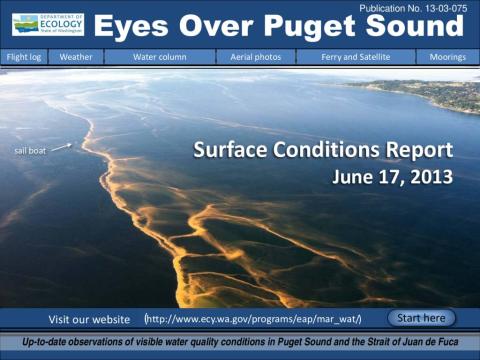
After 2-years of conditions favorable for water quality, with colder temperatures and higher oxygen, Puget Sound water conditions are closer to expected again. This year phytoplankton blooms and seasonal oxygen maxima are notable, while extensive Noctiluca blooms showed up early following a period high freshwater inputs and milder weather conditions. The Fraser River sediment influence is very strong north of San Juan Islands and warm, fresh water is entering Central Puget Sound from Whidbey Basin. In the past few weeks river flows and air temperatures have been higher than normal and now are decreasing.

A new Chinook monitoring framework is designed to build cooperation among managers and policymakers working across the Puget Sound watershed. The report, prepared by an independent team of scientists and released by NOAA, includes a regionally specific, common classification system for Chinook habitats and key ecological attributes. 

The Puget Sound Recovery Implementation Technical Team has released a draft of a NOAA technical memorandum describing frameworks for adaptive management and monitoring of Chinook salmon in Puget Sound. Download the report.

A recent summary includes information compiled in Winter 2013 by the modeling workgroup of the Puget Sound Ecosystem Monitoring Program (PSEMP). It describes several ecosystem modeling efforts in the region.