Monitoring

Monitoring encompasses the routine measurement of ecosystem indicators to assess the status and trends of ecosystem structure and function. Broadly, there are two goals for monitoring in the Puget Sound ecosystem. The first goal is to monitor status and trends of the ecosystem. This may take the form of snapshots of specific regions, or, more usefully, status monitoring tracks variability in carefully selected indicators over time. Status monitoring is fundamentally concerned with documenting spatial and temporal variability in ecosystem components and thus ideally relies on consistent long-term monitoring in a network of sites. A second aim of monitoring is to evaluate the effectiveness of management strategies. Effectiveness monitoring thus aims to detect changes in ecosystem status that are caused by specific management actions.

Sources:

Puget Sound Science Review

Additional resources:

Puget Sound Ecosystem Monitoring Program

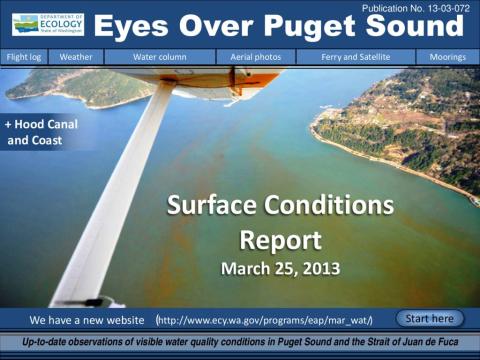
Eyes Over Puget Sound

Overview

The Puget Sound Ecosystem Monitoring Program (PSEMP) is an independent program established by state and federal statute to monitor environmental conditions in Puget Sound. 

PSEMP logo

Related Articles

An indicator species is an organism whose presence, absence or abundance reflects a specific environmental condition. Indicator species can signal a change in the biological condition of a particular ecosystem, and thus may be used as a proxy to diagnose the health of an ecosystem. For example, plants or lichens sensitive to heavy metals or acids in precipitation may be indicators of air pollution. Indicator species can also reflect a unique set of environmental qualities or characteristics found in a specific place, such as a unique microclimate. However, care must be exercised in using indicator species. Judging an ecosystem based

The Sauk-Suiattle Indian Tribe conducts annual surveys of amphibian egg masses in the Reservation Slough wetland near the Sauk River.

Download a November 2012 assessment of monitoring of viable salmonid population (VSP) criteria. 
The pattern of colder and fresher Puget Sound water persists. Jellyfish aggregations continue to persist in Budd Inlet. Debris lines are numerous and long. There are multiple oil sheens in Seattle waterways. CDOM (colored dissolved organic matter) sensor and en route ferry thermosalinograph provide an important tracer for freshwater entering Puget Sound from Whidbey Basin.
The weather has been warm, cloudy with weak winds from the south. Surface water temperatures range from 8.5-9.5°C. River flows are dropping below expected levels, yet the seasonal increase in freshwater can be clearly seen. Debris lines are numerous near river estuaries. Algal biomass is down but jellyfish aggregations continue to go strong in terminal inlets.

A recent report by an independent science panel reviewed data on the effects of salmon fisheries on Southern Resident Killer Whale populations. The report was released on November 30, 2012 and was commissioned by NOAA Fisheries and Oceans Canada.