Monitoring

Monitoring encompasses the routine measurement of ecosystem indicators to assess the status and trends of ecosystem structure and function. Broadly, there are two goals for monitoring in the Puget Sound ecosystem. The first goal is to monitor status and trends of the ecosystem. This may take the form of snapshots of specific regions, or, more usefully, status monitoring tracks variability in carefully selected indicators over time. Status monitoring is fundamentally concerned with documenting spatial and temporal variability in ecosystem components and thus ideally relies on consistent long-term monitoring in a network of sites. A second aim of monitoring is to evaluate the effectiveness of management strategies. Effectiveness monitoring thus aims to detect changes in ecosystem status that are caused by specific management actions.

Sources:

Puget Sound Science Review

Additional resources:

Puget Sound Ecosystem Monitoring Program

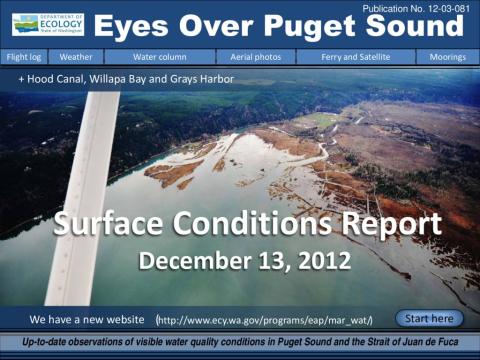
Eyes Over Puget Sound

Overview

The Puget Sound Ecosystem Monitoring Program (PSEMP) is an independent program established by state and federal statute to monitor environmental conditions in Puget Sound. 

PSEMP logo

Related Articles

Recent worldwide increases in the abundance of some jellyfish have been associated with human-caused disturbances to the environment such as eutrophication, overfishing and climate warming.

Washington State's ocean acidification initiative began with the launch of Governer Christine Gregoire's Blue Ribbon Panel on Ocean Acidification in December 2011. The initiative is the first of its kind in the country, and a report commissioned by the Global Ocean Health Program was released in November 2012. The report is a first step towards assessing and improving the tools at hand.

Temperatures range from 9-11°C. Red-brown blooms and jellyfish continue in terminal inlets. Low fluorescence throughout Central Sound and Admiralty Inlet. Since 2011 much colder and much fresher and oxygen levels are up.
Low to moderate fluorescence in northern Puget Sound. Red-brown blooms, and large jellyfish aggregations in the inlets of South and Central Sound. Dry weather and decreased thickness of the freshwater layer in Possession Sound.

Protection Island, a National Wildlife Refuge in the Strait of Juan de Fuca, provides important habitat for seabirds and marine mammals.

The Puget Sound Marine Waters 2011 report is now available. The report was produced by the Puget Sound Ecosystem Monitoring Program and assesses the condition and quality of the waters of Puget Sound.