Salmonids

Fish in the family Salmonidae (salmon, trout, and charr) are unique in their cultural, economic and ecological role in Puget Sound. Because they utilize a very wide range of aquatic habitat types throughout their life history, they play potentially integral roles in the upland freshwater, nearshore and pelagic marine ecosystems and food webs of Puget Sound. They also provide key trophic links between habitats through their migratory behavior. While there is much variation in the behavior and ecology within and among the different salmonid species in Puget Sound, they typically use freshwater habitats to spawn, after which juveniles emerge and eventually migrate to nearshore estuaries or directly to marine pelagic habitats. The watersheds and nearshore habitats of Puget Sound currently support 8 species of salmon, trout, and charr (NOAA 2007), four of which are listed as Threatened under the Endangered Species Act (ESA). These are Chinook salmon (Oncorhynchus tshawytscha), chum salmon (O. keta), bull trout (Salvelinus confluentus) and steelhead (O. mykiss).

Puget Sound salmon:

Chinook salmon (Oncorhynchus tshawytscha)

Chum salmon (Oncorhynchus keta)

Sockeye salmon (Oncorhynchus nerka)

Pink salmon (Oncorhynchus gorbuscha)

Coho salmon (Oncorhynchus kisutch)

Puget Sound trout

Steelhead (Oncorhynchus mykiss)

Cutthroat trout (Oncorhynchus clarki clarki)

Puget Sound charr

Bull trout (Salvelinus confluentus

-- Source: Puget Sound Science Review

Overview

Fish in the family Salmonidae (salmon, trout, and charr) play potentially integral roles in the upland freshwater, nearshore and pelagic marine ecosystems and food webs of Puget Sound.

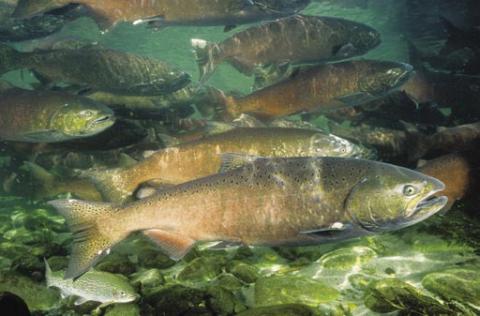
Chum salmon (Oncorhynchus keta). Image courtesy U.S. Fish and Wildlife Service.

Related Articles

Fish in the family Salmonidae (salmon, trout, and charr) play potentially integral roles in the upland freshwater, nearshore and pelagic marine ecosystems and food webs of Puget Sound.
The State of Our Watersheds Report is produced by the treaty tribes of western Washington, and seeks to present a comprehensive view of 20 watersheds in the Puget Sound region and the major issues that are impacting habitat.

The Tulalip reservation is located near Marysville, Washington. It was created after the Point Elliott Treaty of 1855, and currently has a population of 2,500 members. The entire tribal population is approximately 4,000 and growing. 

Tulalip Tribes Area of Concern:

The Snohomish River basin, part of the region where the Tulalip tribes focus restoration efforts, suffers from extensive shoreline armoring and a history of draining and clearing wetland habitat. In order to protect salmon stocks, the tribes closed many of their usual and accustomed fishing areas to Chinook harvest, and have worked to reduce potentially harmful impact of hatchery fish

The Stillaguamish Tribe is descended from the Stoluck-wa-mish River Tribe, who signed the treaty of Point Elliott in January 1855. Some tribal members moved to the Tulalip reservation, while others remained along the Stillaguamish River. The headquarters for the tribe are in Arlington, Washington.

Stillaguamish Area of Concern:

The Stillaguamish watershed is largely undeveloped, but population growth has put pressure on resources and salmon habitat. Continued loss and fragmentation of habitat is a primary concern, and protecting existing habitat is necessary for the survival of Chinook in the Stillaguamish. Salt marsh habitat, which provides feeding ground for outgoing juvenile Chinook

The Skokomish Tribe began as the Twana Indians, made up of nine communities living in and around the Hood Canal drainage basin.

Skokomish Area of Concern:

The tribe focuses restoration efforts in the Skokomish-Dosewallips basin (WRIA 16). Land use in this basin is concentrated along Hood Canal, since much of the remaining land falls under federal jurisdiction. Expanding development is a concern, especially as water demand increases. Aggressive timber harvesting in the last 15 years has left the watershed in need of serious restoration work. Both the Skokomish River and Hood Canal have elevated fecal coliform levels, which are partly

The diversity of streams in the county is a reflection of the diversity of its geography. From the small rivulets that begin high in the Cascade Mountains, to the brooks that flow gently across the lowlands, to the five major rivers of the county, there are over 4,800 kilometers (3,000 miles) of perennial streamcourses in King County.

Despite the impressive total length, King County has no rivers that are longer than 150 kilometers (93 miles). For two of the rivers—the South Fork of the Skykomish and the White—only a portion of their length flows through King County. But geography has