Fish in the family Salmonidae (salmon, trout, and charr) are unique in their cultural, economic and ecological role in Puget Sound. Because they utilize a very wide range of aquatic habitat types throughout their life history, they play potentially integral roles in the upland freshwater, nearshore and pelagic marine ecosystems and food webs of Puget Sound. They also provide key trophic links between habitats through their migratory behavior. While there is much variation in the behavior and ecology within and among the different salmonid species in Puget Sound, they typically use freshwater habitats to spawn, after which juveniles emerge and eventually migrate to nearshore estuaries or directly to marine pelagic habitats. The watersheds and nearshore habitats of Puget Sound currently support 8 species of salmon, trout, and charr (NOAA 2007), four of which are listed as Threatened under the Endangered Species Act (ESA). These are Chinook salmon (Oncorhynchus tshawytscha), chum salmon (O. keta), bull trout (Salvelinus confluentus) and steelhead (O. mykiss).
Puget Sound salmon:
Chinook salmon (Oncorhynchus tshawytscha)
Chum salmon (Oncorhynchus keta)
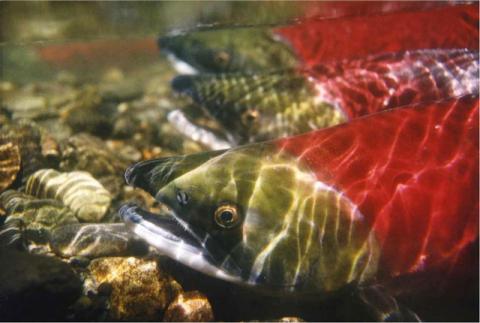
Sockeye salmon (Oncorhynchus nerka)
Pink salmon (Oncorhynchus gorbuscha)
Coho salmon (Oncorhynchus kisutch)
Puget Sound trout
Steelhead (Oncorhynchus mykiss)
Cutthroat trout (Oncorhynchus clarki clarki)
Puget Sound charr
Overview
Fish in the family Salmonidae (salmon, trout, and charr) play potentially integral roles in the upland freshwater, nearshore and pelagic marine ecosystems and food webs of Puget Sound.