

Find content specifically related to marine mammals of the Puget Sound and Salish Sea ecosystems. For checklists and descriptive accounts of individual species, visit our species library's marine mammals page.
Marine mammals
Related Articles

Cuvier’s beaked whales are the most commonly stranded beaked whale along the outer coasts of Oregon and Washington. Although typically a creature of deep water, beaked whales have been documented in the Salish Sea at least once in the last fifty years, although which species was swimming in Puget Sound was not clear.
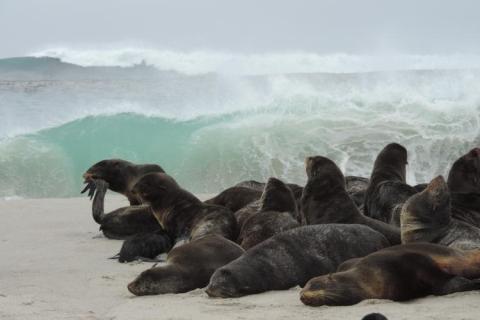
Adult northern fur seals spend more than 300 days per year (about 80 percent of their time) at sea. During the summer and autumn they intermittently fast while on land and feed at sea. During the winter and spring they are pelagic, occupying the North Pacific Ocean as well as the Bering and Okhotsk Seas. Northern fur seals are considered rare in the Salish Sea, and there have been 93 confirmed sightings of stranded animals in the state of Washington since 1982.

Although rare in the Salish Sea, bottlenose dolphins are among the best-studied marine mammals in the world. Sightings of live and stranded animals have been increasing in local waters for the past two decades.

Bryde’s whales are rarely seen in the Salish Sea, preferring warmer waters, but at least three have been documented here since 2010.

The largest of the beaked whales, Baird’s beaked whales can grow to a length of nearly eleven meters and weigh nearly twelve thousand kilograms. Due to their preference for deeper waters, Baird’s beaked whales are somewhat rare in the Salish Sea with sightings mostly confined to the recovery of stranded animals.

The Guadalupe fur seal is not officially recognized as a Washington state marine mammal, but more than 160 strandings along the coast, and several sightings in the Salish Sea, suggest they are more common here than previously thought.