

Find content specifically related to marine mammals of the Puget Sound and Salish Sea ecosystems. For checklists and descriptive accounts of individual species, visit our species library's marine mammals page.
Marine mammals
Related Articles
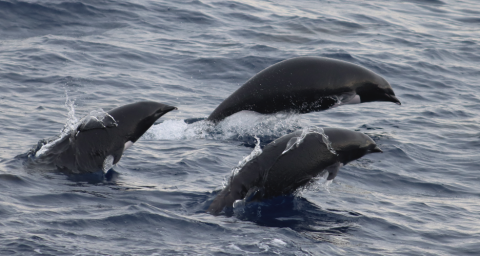
Overview
The northern right whale dolphin (Lissodelphis borealis) is one of the most unusual marine mammals of the North Pacific Ocean. It is the only dolphin species in the Northern Hemisphere with no hint of a dorsal fin, and it is very slender and streamlined, making it appear almost eel-like. Northern right whale dolphins are found only in cool temperate waters of the North Pacific and are moderately common in offshore waters. However, they are uncommon in nearshore regions and rarely enter inshore bays or channels. While they have been sighted here, their occurrence in Puget Sound and the Salish
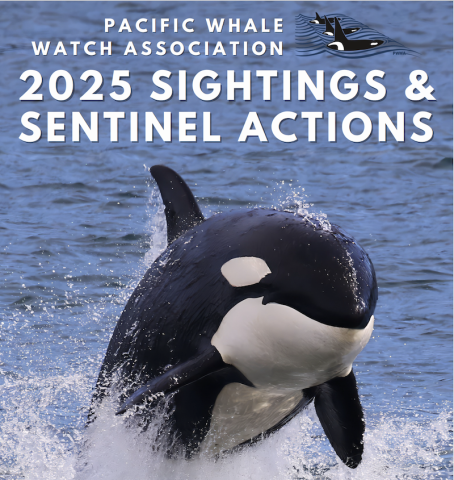
The Pacific Whale Watch Association (PWWA) is a community of ecotourism professionals with a shared commitment to education, conservation, and responsible wildlife viewing in Washington state and British Columbia. The 2025 PWWA annual report summarizes wildlife sightings and sentinel actions logged by members throughout the year. Sentinel actions are protective measures taken by professional whale watchers, such as warning vessels near whales or removing marine debris.
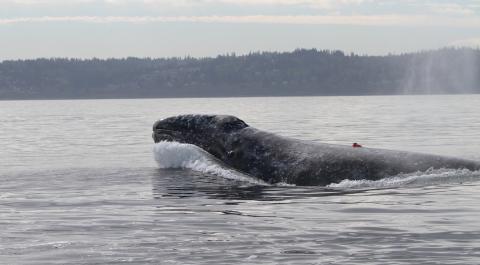
The Cascadia Research Collective has prepared an overview of the status and trends for gray whales in our region.
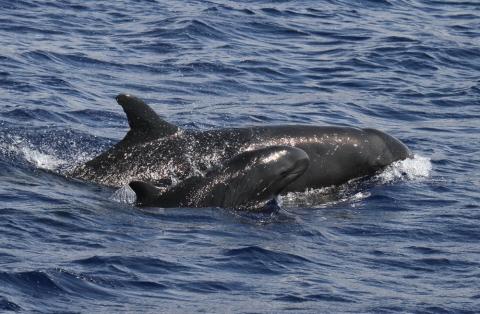
Overview
The false killer whale is a tropical to warm temperate species of dolphin that is not normally found in the Salish Sea. However, the species does occasionally appear in small numbers in Pacific Northwest waters of Washington and British Columbia, and even sometimes as far north as Alaska. They are highly social animals that typically feed on large pelagic fish, such as tuna and mahi mahi.
Status, trends & events
False killer whales are considered naturally rare, and there are no global estimates of abundance, but they generally occur in low densities across their extensive range (Zaeschmar and Baird 2025)
Overview
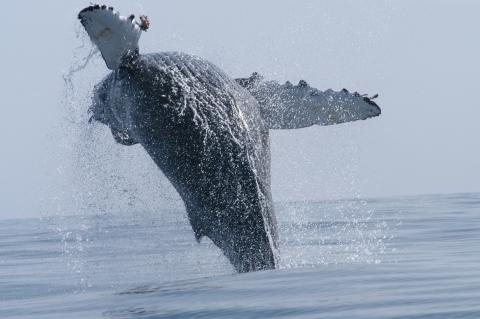
Humpback whales have made a remarkable recovery in Puget Sound and throughout the Salish Sea. While their numbers vary through the season, they can be seen in almost any month of the year. In essence, this has been a return to waters they formerly used prior to commercial whaling that wiped out the local population. Humpback whales around the world have made strong recoveries from whaling and now number some 30,000 in the North Pacific but there are some major differences in how populations in different areas have fared. Humpbacks are baleen whales that engulf small prey including krill
The year 2025 has been fairly mystifying to experts who make their living studying natural systems in the Puget Sound region.
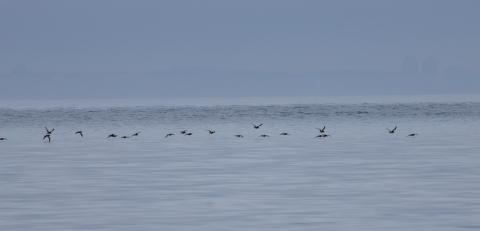
Unusual observations this year include record-low dissolved oxygen levels, unexpected gray whale visitations, and the sudden arrival of an astounding number of short-tailed shearwaters — a seabird almost never seen in Puget Sound.
Cold waters rising from the deep along the West Coast helped to rescue Puget Sound from an oceanic heat wave bringing warm-water troubles to other parts of the Pacific Ocean. But our inland waterway has had its own problems, and the reasons have been a challenge