

Find content specifically related to marine mammals of the Puget Sound and Salish Sea ecosystems. For checklists and descriptive accounts of individual species, visit our species library's marine mammals page.
Marine mammals
Related Articles
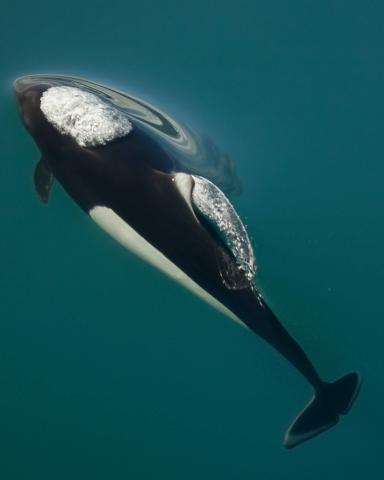
Dall’s porpoises have declined in the Salish Sea since the early 1990s for reasons that are unknown. However, the species, which remains abundant in inshore waters of Alaska and in open coastal and offshore waters of the North Pacific Ocean, is not considered threatened or endangered. Major threats to Dall’s porpoise populations include direct hunting, by-catch in fisheries, and the impacts of environmental contaminants.

A scientific paper, published on March 27th, spells out the unique physical and genetic characteristics that should make each group a separate species, with the proposed scientific names Orcinus ater for residents and Orcinus rectipinnus for Bigg’s.
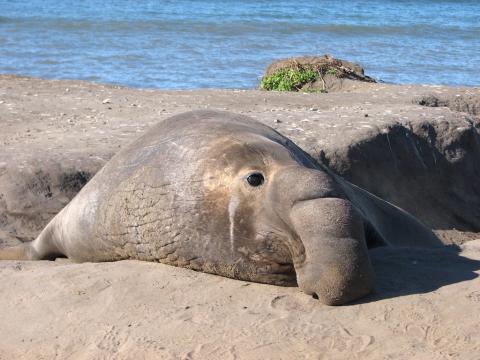
Northern elephant seals were hunted heavily in the 19th century and believed to be extinct by 1892. However, a small remnant population (~50–100 animals) off the western coast of Mexico grew to populations in the United States and Mexico to at least 220,000 individuals as of 2010. Elephant seals are distributed in the central and eastern North Pacific Ocean, from as far north as Alaska down to southern Baja California. Sightings of elephant seals were once considered rare in the Salish Sea, but increasingly single individuals are known to haul out onto sandy beaches on Smith, Protection, and Whidbey Islands. In 2010, a local breeding population established itself along the lower west side of Whidbey Island in Puget Sound.

Puzzling encounters between endangered killer whales and harbor porpoises point to questions about prey availability and whale culture, scientists say. Are the whales playing, practicing their hunting skills, or is something else going on?
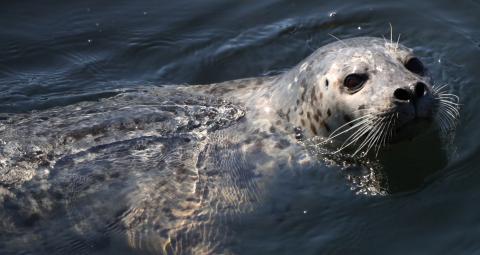
Harbor seals were hunted from the 1870s to 1970s until they were protected in the United States by the 1972 Marine Mammal Protection Act and in Canada under the 1970 Marine Mammal Regulations in the Fisheries Act. The inland Washington harbor seal stock is estimated to be over 12,000, while the Strait of Georgia sustains approximately 39,000 harbor seals. Key threats include human disturbance, habitat degradation, loss of prey, and interaction with fishing gear and boats.
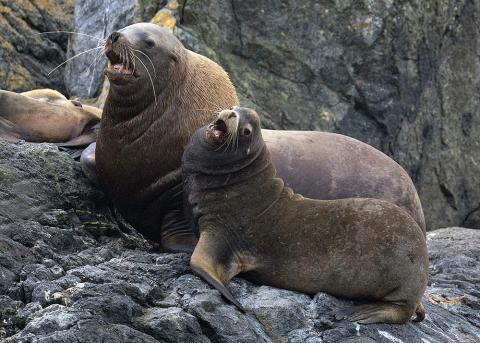
Steller sea lions use Puget Sound as a feeding area from autumn through spring when they are not breeding in British Columbia and Alaska during summer. While the Western Stock of the species is considered Endangered under the US Endangered Species Act (ESA), the Eastern Stock, which occurs in Puget Sound, is increasing in numbers and not listed under the ESA.