Marine habitat

The Marine System encompasses all coastal areas not appreciably diluted by freshwater (surface salinities seldom falling below 30 ppt), including open coastal areas, straits, and euhaline inland waters.  It can extend from the outer edge of the continental shelf to (1) the landward limit of tidal inundation or wave splash or (2) the seaward limit of the Estuarine System.

Source:

Dethier, M.N. 1990. A marine and estuarine habitat classification system for Washington State. Natural Heritage Program, WA DNR, Olympia, WA. 60 pp.

Overview

Each year, the Puget Sound Ecosystem Monitoring Program releases the annual Puget Sound Marine Waters Overview report. The latest report combines a wealth of data from comprehensive monitoring programs and provides a concise summary of what was happening in Puget Sound’s marine waters during 2022. The report represents the collective effort of 84 contributors from federal, tribal, state, and local agencies, academia, nonprofits, and private and volunteer groups.

Image of a sailboat on the water at sunset.Text overlay reads: Puget Sound Marind Waters 2022 Overview.

Related Articles

After a dry early summer followed by more than expected rain, rivers mostly remained lower than in 2018. In October air temperatures dropped, but water temperatures remained warm enough for spawning anchovies in South and Central Sound and herring and salmon optimal growth in Whidbey Basin. By the end of October many red-brown blooms vanished, yet the waters of South Sound are still green, adorned with rafts of organic debris in many places. Read what happened the year before in the Puget Sound Marine Waters 2018 Overview.

A new report from the Puget Sound Ecosystem Monitoring Program says climate change altered the base of Puget Sound's food web in 2018, diminishing microscopic phytoplankton necessary for marine life. Scientists also observed lower abundances of fish, seabirds, and marine mammals.

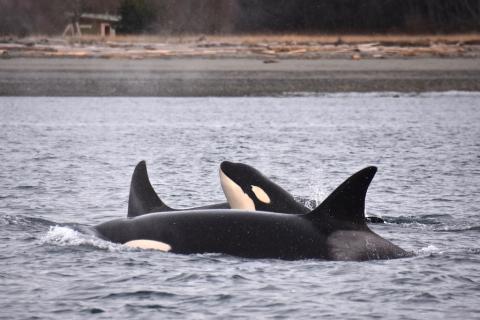
Officially known as West Coast transients but increasingly referred to as Bigg’s killer whales, these marine mammal-eating orcas (Orcinus orca) are spending increasing time in the Salish Sea to consume their marine mammal prey including harbor seals, Steller sea lions, and harbor and Dall’s porpoise. They range from Southeast Alaska to California, but over the last 15 years more members of the population are spending increasing time in the inland waters of Washington State and British Columbia (Houghton et al. 2015, Shields et al. 2018). They have no predators (except perhaps occasionally other Bigg’s killer whales - see Towers et al. 2018), but are at risk from anthropogenic effects, including toxics and noise pollution (Ford et al. 2007).

Notes and biography about the history of the department of oceanography at the University of Washington (1903-1980) as reported by oceanagrapher Eugene Collias. Report courtesy of the Collias estate.

This year, air temperatures were warmer than in previous years, and this pattern is predicted to continue. Precipitation was low and is now improving, yet river flows remain low. By August, Puget Sound surface water temperatures were 0.6 °C warmer across all regions; this could have shifted the timing of optimal temperatures for some marine organisms. In September, blooms are limited to inlets. Jellyfish are abundant in Sinclair Inlet, and anchovies reside in Eld Inlet. Macroalgae are still plentiful. Learn about the benefits of beach wrack and a DNA barcoding project supported by Ecology.

Spring and fall Chinook salmon were thought to be alike until researchers discovered a gene for early migration. Now, federal biologists and legal experts are struggling to decide if spring Chinook should be granted their own legal protection under the Endangered Species Act.