Marine habitat

The Marine System encompasses all coastal areas not appreciably diluted by freshwater (surface salinities seldom falling below 30 ppt), including open coastal areas, straits, and euhaline inland waters.  It can extend from the outer edge of the continental shelf to (1) the landward limit of tidal inundation or wave splash or (2) the seaward limit of the Estuarine System.

Source:

Dethier, M.N. 1990. A marine and estuarine habitat classification system for Washington State. Natural Heritage Program, WA DNR, Olympia, WA. 60 pp.

Overview

Each year, the Puget Sound Ecosystem Monitoring Program releases the annual Puget Sound Marine Waters Overview report. The latest report combines a wealth of data from comprehensive monitoring programs and provides a concise summary of what was happening in Puget Sound’s marine waters during 2022. The report represents the collective effort of 84 contributors from federal, tribal, state, and local agencies, academia, nonprofits, and private and volunteer groups.

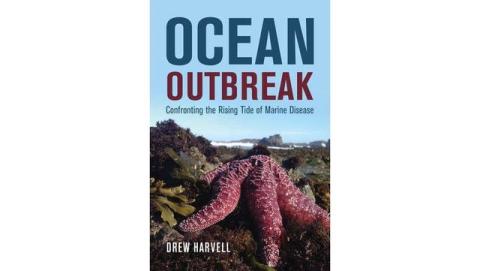
Image of a sailboat on the water at sunset.Text overlay reads: Puget Sound Marind Waters 2022 Overview.

Related Articles

As officials struggle to track and contain the outbreak of the novel coronavirus known as COVID-19, ecologists say widespread impacts from viruses and other pathogens are also a growing threat to the species of the Salish Sea ecosystem.

High levels of mercury and other toxic chemicals are showing up in seemingly remote and pristine parts of the Puget Sound watershed, the result of atmospheric deposition. Scientists talk about a “dome” of pollution hanging over urban areas, leading to a never-ending cycle of persistent compounds working their way through the air, onto the land and into the water.

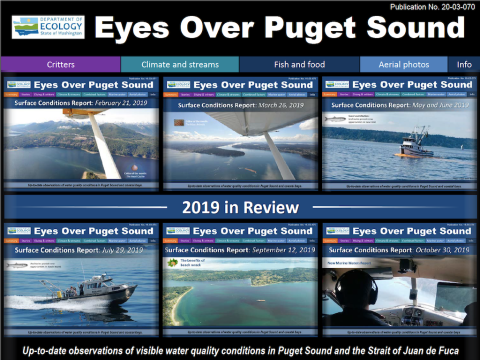
The Washington State Department of Ecology has prepared a summary review of its Eyes Over Puget Sound surface condition reports from 2019. The year started with snow, and a summer drought kept river flows low. As a result, salinities in Puget Sound were elevated year round. Warmer surface water temperatures in spring gradually extended to greater depth by late summer. The spring bloom was strong, and South Sound provided optimal conditions for anchovies that showed up in high numbers. A coccolithophore bloom stained Hood Canal turquoise, and Port Angeles and Discovery Bay were colored red-brown by strong blooms. Noctiluca and macroalgae, both known eutrophication indicators in coastal regions, were abundant in Central Sound, and extended into South Sound and Whidbey Basin. Large numbers of jellyfish occurred in Quartermaster Harbor, Sinclair Inlet, and parts of Orcas Island.

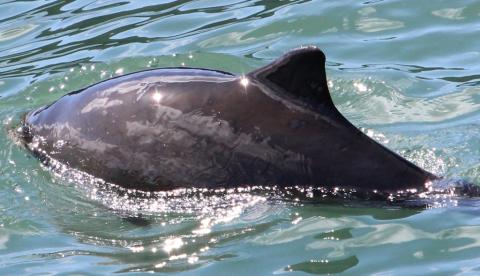
Harbor porpoises declined dramatically in the Salish Sea in the 1970s but their populations have since rebounded, increasing by more than 10% per year in recent decades. A 2020 report for the Encyclopedia of Puget Sound examines harbor porpoise status and trends, natural history and recent policy considerations for the species.

Last summer, scientists met at the University of Washington to address alarming findings concerning the rapid acidification of the world's oceans. Experts at that symposium warned that wildlife in the Salish Sea, from salmon to shellfish, may start to see significant effects from changing water chemistry within the next 10 to 20 years. This article summarizes the symposium's key findings and was commissioned and edited by the Washington Ocean Acidification Center which hosted the gathering. Funds for the article were provided by the Washington state legislature. [A version of this article was originally published by the Washington Ocean Acidification Center.]

Scientists are still trying to understand what caused the deaths of thousands of rhinoceros auklets in the Salish Sea in 2016. Some studies point to disease as a central factor in that incident and potentially other large seabird die-offs along the coast. That is prompting a deeper look at what makes these birds sick, and how local populations are faring. We followed a group of researchers as they gave a health checkup to a breeding colony of rhinoceros auklets on Protection Island.