Marine habitat

The Marine System encompasses all coastal areas not appreciably diluted by freshwater (surface salinities seldom falling below 30 ppt), including open coastal areas, straits, and euhaline inland waters.  It can extend from the outer edge of the continental shelf to (1) the landward limit of tidal inundation or wave splash or (2) the seaward limit of the Estuarine System.

Source:

Dethier, M.N. 1990. A marine and estuarine habitat classification system for Washington State. Natural Heritage Program, WA DNR, Olympia, WA. 60 pp.

Overview

Each year, the Puget Sound Ecosystem Monitoring Program releases the annual Puget Sound Marine Waters Overview report. The latest report combines a wealth of data from comprehensive monitoring programs and provides a concise summary of what was happening in Puget Sound’s marine waters during 2022. The report represents the collective effort of 84 contributors from federal, tribal, state, and local agencies, academia, nonprofits, and private and volunteer groups.

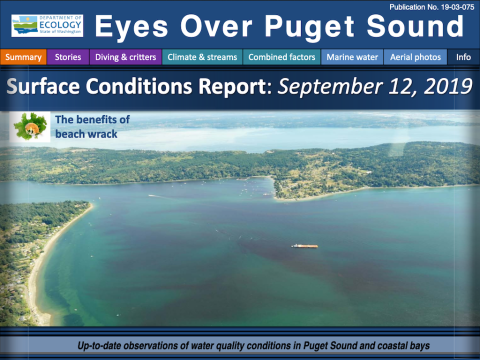
Image of a sailboat on the water at sunset.Text overlay reads: Puget Sound Marind Waters 2022 Overview.

Related Articles

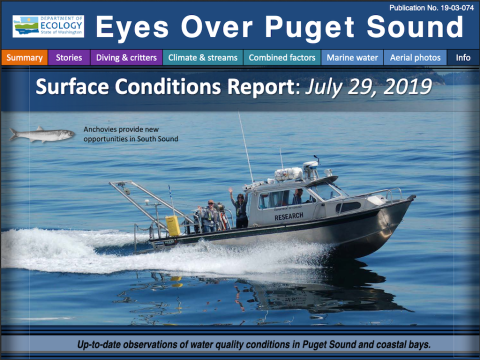
In July, the recent trends of warm, dry conditions lessened; however, river flows remain low. Extensive macroalgae drifted through South and Central Sound and washed up on beaches. Macroalgae growth is fueled by excessive nutrients and sunshine. When it washes onto the beach, it is called beach wrack, and it can be a health risk to beachgoers because of bacteria it can harbor. From our aerial photography, we saw that Southern Hood Canal looks tropical because of a bloom of coccolithophores coloring the water turquoise. Schools of fish congregate in South Sound and southern Hood Canal. Jellyfish are abundant in Quartermaster Harbor.

Pigeon guillemots have attracted relatively little scientific attention compared to other seabirds in Puget Sound. That may be because their population is generally stable, but a group of citizen scientists is helping to put guillemots on the conservation radar. They hope the birds can be used as an indicator of Puget Sound health.

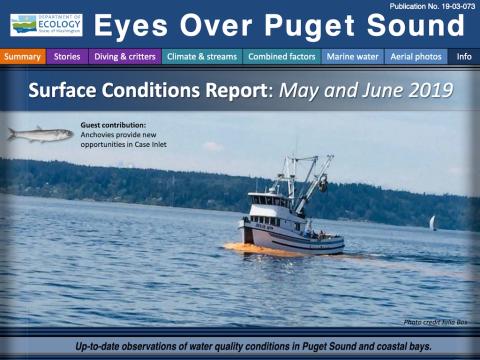
Warm and dry conditions this spring are predicted to persist into summer, resulting in saltier and warmer than normal Puget Sound water conditions. Early upwelling and a premature melt of the snowpack means nutrient-rich ocean water likely already entered Puget Sound. This sets the stage for a lot of biological activity. From the air, it is obvious that the productive season is in full swing. We saw large algae blooms in Central Sound along with abundant Noctiluca.  Huge numbers of anchovies were documented in Case Inlet and other finger inlets in South Sound, attracting hundreds of marine mammals.

Eight aquatic reserves in Puget Sound are being studied by volunteers working under the direction of state experts. Washington Department of Natural Resources manages the reserves with guidance from nearby communities.

Eight aquatic reserves, managed by the Washington Department of Natural Resources, have been established to protect important ecosystems on state aquatic lands.

In most reserves, area residents work with state, local and tribal officials and nonprofit groups to develop and carry out management plans, including scientific research.

The aquatic reserves in the order they were established include: 

  • Maury Island 2004
  • Cypress Island  2007
  • Fidalgo Bay 2008
  • Cherry Point 2010
  • Protection Island 2010
  • Smith and Minor Islands 2010
  • Nisqually Reach 2011
  • Lake Kapowsin 2016

Following a generally warmer and drier winter and then a cold spell in February, Puget Sound waters are cold for anchovies. The productive season is in full swing with algal blooms spotted in South Sound, Kitsap Peninsula, and Quartermaster Harbor. Jellyfish are abundant in some inlets, and Noctiluca stains the water orange in Hood Canal. We collect monthly data to keep you informed about the conditions around Puget Sound. Come into the lab and see how we assure the highest data quality from our field instruments!