Monitoring

Monitoring encompasses the routine measurement of ecosystem indicators to assess the status and trends of ecosystem structure and function. Broadly, there are two goals for monitoring in the Puget Sound ecosystem. The first goal is to monitor status and trends of the ecosystem. This may take the form of snapshots of specific regions, or, more usefully, status monitoring tracks variability in carefully selected indicators over time. Status monitoring is fundamentally concerned with documenting spatial and temporal variability in ecosystem components and thus ideally relies on consistent long-term monitoring in a network of sites. A second aim of monitoring is to evaluate the effectiveness of management strategies. Effectiveness monitoring thus aims to detect changes in ecosystem status that are caused by specific management actions.

Sources:

Puget Sound Science Review

Additional resources:

Puget Sound Ecosystem Monitoring Program

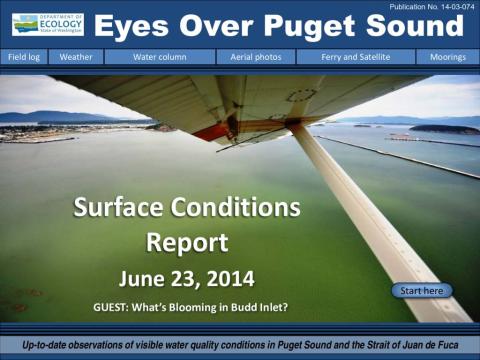
Eyes Over Puget Sound

Overview

The Puget Sound Ecosystem Monitoring Program (PSEMP) is an independent program established by state and federal statute to monitor environmental conditions in Puget Sound. 

PSEMP logo

Related Articles

The weather changed from cool, cloudy and southerlies, to sunny warm conditions and light northerly winds on Mother’s Day. At the water surface, blooms and large debris lines occur in Bellingham, Padilla, and Samish Bays, Hood Canal, East Sound, and the Straits, as well as the finger inlets of South Sound. Large amounts of sediment-laden water from Port Susan are flowing into Central Basin. Turquoise water mixing to the surface in places around the San Juan Islands. After some trouble-shooting of the hardware and communication system, we will resume collecting Victoria Clipper data next week. Meet Eyes Under Puget Sound: Sediment Monitoring Program at Ecology.
Air temperatures have been slightly warmer and river flows are higher. Blooms are present only in Whidbey Basin and isolated bays. The water column otherwise is relatively clear. Sediment rich water is entering from the Stillaguamish River. Debris lines were visible in Hood Canal and North Sound. Multiple reported oil sheens seen in Lake Washington Ship Canal. Generally, the year 2014 started colder and saltier throughout Puget Sound. Oxygen is lower in Whidbey Basin, Central and South Sound, but higher in Hood Canal. Upwelling favorable conditions stimulate a spring phytoplankton bloom off the Washington coast.

Thousands of different compounds are produced and used as part of our daily lives.  Examples include pharmaceuticals (NSAIDs, birth control pills, etc), personal care products (sun screen agents, scents, preservatives, etc), food additives (artificial sweeteners) and compounds used in industrial and commercial applications (flame retardants, antibiotics, etc).  Advances in analytical methods have allowed the detection of many of these compounds in the environment.

Harbor porpoise (Phocoena phocoena) are one of the most frequently sighted cetaceans in the Salish Sea. Anecdotal information, possibly supported with stranding encounter rate data, suggests that harbor porpoise may have increased in Puget Sound, or have shifted their distribution back to Puget Sound relative to earlier decades.

Harbor porpoises were once common in Puget Sound, but had all but disappeared from local waters by the 1970s. Regular and numerous anecdotal sightings in recent years show that populations of these cetaceans are now increasing and may be approaching their former status. The attached document from NOAA Fisheries describes harbor porpoise numbers and their geographic range in Puget Sound as of 2011. 

HARBOR PORPOISE (Phocoena phocoena vomerina): Washington Inland Waters Stock (NOAA Fisheries 2011)

River flows are above normal and air temperatures are increasing slowly. The spring phytoplankton bloom is slow to develop with visible blooms limited to smaller bays such as Sequim and Bellingham Bays. Noctiluca observed in East Sound on Orcas Island, coinciding with high numbers of jellyfish. Debris lines are mostly confined to Hood Canal. Pockets of colder water observed in Central Sound and Hood Canal, likely from the colder, saltier conditions that developed during the winter in the northern regions. Oxygen is variable yet close to expected ranges. Sizable oil sheens were sighted in Gig Harbor and Carr Inlet.