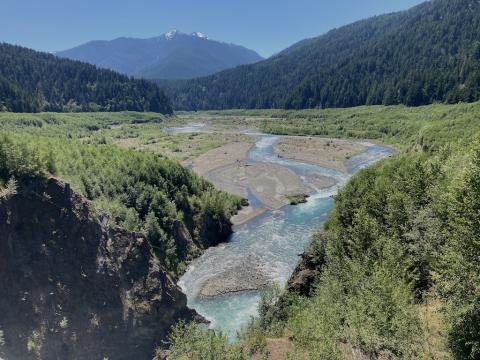
The return of sockeye to the Elwha River is intriguing scientists. Could nearby freshwater kokanee help re-establish resident populations? We continue with part four of our series 'Returning home: The Elwha's genetic legacy.'
Following dam removal, migratory salmon have been free to swim into the upper Elwha River for the first time in 100 years. Their actual behaviors and reproductive success may well be driven by changes in their genetic makeup. Our seven-part series 'Returning home' examines how the fish are doing and whether the Elwha's genetic legacy remains intact.
Migration patterns have apparently reawakened for the Elwha River's wild steelhead. Studies show that the fish may have retained much of their genetic drive despite 100 years of being trapped behind dams. We continue our series 'Returning home: The Elwha's genetic legacy' with part two of seven.
Our series 'Returning home: The Elwha's genetic legacy' continues with a look at the possible return of spring Chinook to the upper portions of the Elwha River. We bring you part three of seven.
Puget Sound's glaciers are melting rapidly due to climate change. The North Cascades mountains have lost about 56% of their glacial ice while estimates show that glaciers in the Olympics could be gone within the next 50 years. Scientists say salmon and other species could be hard hit as the region loses its “giant storage tank” of ice.
Can restoring the natural balance of the Nooksack River also reduce flood risks? Officials on both sides of the U.S.-Canada border are taking note as climate change raises the stakes.
How can Puget Sound generate more salmon? That question has been at the center of ecosystem recovery efforts for decades. But even as scientists and conservationists make progress on many fronts — from breaching dams to cleaning up the water — they have faced one especially complicated and frustrating limitation: Salmon need more estuaries. We look at how local tribes are working to restore this critical habitat.
Scientists think they may have discovered a lost population of native kokanee salmon in Lake Washington. Salmon watchers are monitoring local creeks this fall to confirm the finding.
Warming waters threaten the recovery of salmon in Puget Sound. New findings about stream temperature could help salmon survive the threats of climate change.
A 2021 paper in the journal PLoS ONE provides a clearer picture of what endangered southern resident orcas eat throughout the year. Chinook salmon make up the bulk of the whales' diet, but the paper suggests that other salmon species and non-salmonid fishes can also play important roles depending on the season.