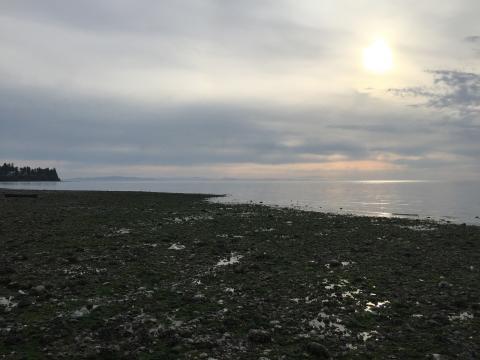
Marine habitat

The Marine System encompasses all coastal areas not appreciably diluted by freshwater (surface salinities seldom falling below 30 ppt), including open coastal areas, straits, and euhaline inland waters.  It can extend from the outer edge of the continental shelf to (1) the landward limit of tidal inundation or wave splash or (2) the seaward limit of the Estuarine System.

Source:

Dethier, M.N. 1990. A marine and estuarine habitat classification system for Washington State. Natural Heritage Program, WA DNR, Olympia, WA. 60 pp.

Overview

Each year, the Puget Sound Ecosystem Monitoring Program releases the annual Puget Sound Marine Waters Overview report. The latest report combines a wealth of data from comprehensive monitoring programs and provides a concise summary of what was happening in Puget Sound’s marine waters during 2022. The report represents the collective effort of 84 contributors from federal, tribal, state, and local agencies, academia, nonprofits, and private and volunteer groups.

Image of a sailboat on the water at sunset.Text overlay reads: Puget Sound Marind Waters 2022 Overview.

Related Articles

A 2015 report from the University of Washington Puget Sound Institute summarizes and reviews 14 EPA-funded projects focusing on Puget Sound's marine and nearshore environments. The projects were conducted between 2011-2015 with support from the EPA's National Estuary Program.

A 2015 report from the University of Washington provides the most comprehensive assessment to date of the expected impacts of climate change on the Puget Sound region.

The Lower Duwamish Waterway in Puget Sound was designated a Superfund cleanup site in 2001. Its legacy of contamination predates World War II and the waterway continues to pollute Puget Sound through stormwater runoff.

The Puget Sound Fact Book brings together statistics and other information about the health and makeup of the Puget Sound ecosystem. Areas of focus include climate change, geography, water quality, habitats, human dimensions and regional species. The fact book was prepared for the Encyclopedia of Puget Sound with funding from the Environmental Protection Agency and the Puget Sound Partnership.

A 2015 NOAA report creates an updated and comprehensive list of the fishes of the Salish Sea. 

In the 1940s, harbor porpoise were among the most frequently sighted cetaceans in Puget Sound, but by the early 1970s they had all but disappeared from local waters. Their numbers have since increased, but they remain a Species of Concern in the state of Washington. This in-depth profile looks at harbor porpoise in the Salish Sea, and was prepared by the SeaDoc Society for inclusion in the Encyclopedia of Puget Sound.