Marine habitat

The Marine System encompasses all coastal areas not appreciably diluted by freshwater (surface salinities seldom falling below 30 ppt), including open coastal areas, straits, and euhaline inland waters.  It can extend from the outer edge of the continental shelf to (1) the landward limit of tidal inundation or wave splash or (2) the seaward limit of the Estuarine System.

Source:

Dethier, M.N. 1990. A marine and estuarine habitat classification system for Washington State. Natural Heritage Program, WA DNR, Olympia, WA. 60 pp.

Overview

Each year, the Puget Sound Ecosystem Monitoring Program releases the annual Puget Sound Marine Waters Overview report. The latest report combines a wealth of data from comprehensive monitoring programs and provides a concise summary of what was happening in Puget Sound’s marine waters during 2022. The report represents the collective effort of 84 contributors from federal, tribal, state, and local agencies, academia, nonprofits, and private and volunteer groups.

Image of a sailboat on the water at sunset.Text overlay reads: Puget Sound Marind Waters 2022 Overview.

Related Articles

An annual State of the Pacific Ocean meeting is held to review the physical, biological and selected fishery resources and present the results of the most recent year’s monitoring in the context of previous observations and expected future conditions. The workshop to review conditions during 2014 took place at the Institute of Ocean Sciences, Sidney, B.C. on March 10 and 11, 2015, with over 100 participants both in person and via webinar.

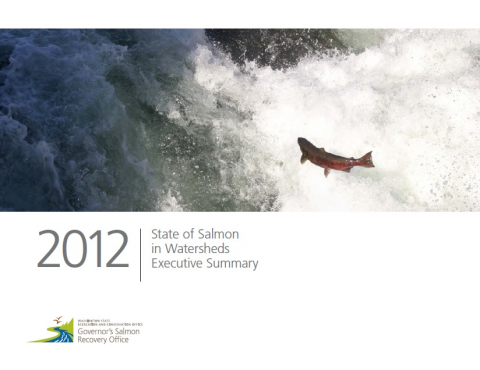
Salmon recovery demands both dedication among people with different interests, and sustained resources. This biennial report tells the story of the progress made to date and the challenges ahead.

Sound Science: Synthesizing Ecological and Socio-economic Information about the Puget Sound Ecosystem summarizes what we know about the greater Puget Sound ecosystem and what we think could happen in the future given present trajectories and trends.

The 2011 Salish Sea Ecosystem Conference was held October 25 to 27 at the Sheraton Wall Centre in Vancouver, British Columbia. This event brought together a diverse group of government officials, community leaders, First Nations and tribal members, environmental managers, scientists and academics to learn from each other about the state and threats to the shared ecosystem. Over 950 delegates attended.

A 2015 paper in the journal Ecological Economics evaluated “personal use” and subsistence use of seafood among commercial operators in Washington and California, as well as the extent, range, and species diversity of noncommercial wild ocean seafood subsistence harvests. 

With its striking plumage and brilliant orange bill, the Tufted Puffin is an iconic seabird well known to native peoples, fishermen, and coastal communities throughout its range in the temperate and sub-arctic North Pacific. Though pelagic in winter, puffins gather on islands and headlands during spring and summer to breed and raise their young. They are members of the auk family, with stocky bodies adapted to “flying” underwater as they dive in pursuit of a wide range of fish and invertebrate prey. Nesting Tufted Puffins range up to 100 km from their breeding colonies to forage for their nestlings, and are famed for carrying 20 or more small fish at one time, neatly lined up and carried crosswise in their large, brightly colored bills.