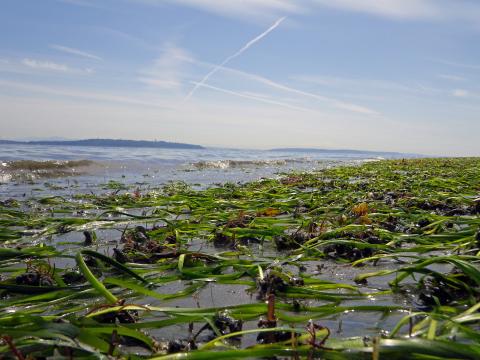
Nearshore habitat

The nearshore habitat of Puget Sound is usually defined as the area from the bluffs that line the shore to the area where water becomes too deep for light to penetrate and allow plants to grow, measured relative to mean lower low water (MLLW). It includes marine habitat and estuarine habitat, but stops at the farthest reach of the tide into an estuary, or the point where saltwater no longer mixes with fresh. Within Puget Sound’s nearshore are many varied habitat types, including rocky and sandy beaches, mudflats, salt marshes, kelp and eelgrass beds, and lagoons.

Sources:

Puget Sound Nearshore Ecosystem Restoration Project: http://www.pugetsoundnearshore.org/technical_reports.html.

Overview

The Puget Sound Nearshore Ecosystem Restoration Project (PSNERP) works to assess the health of Puget Sound nearshore environments and provides strategies for their protection and restoration. 

PSNERP logo

Related Articles

As threatened Chinook populations in Puget Sound continue to lose ground, the state is looking to new strategies to reverse the trend. In the Skagit watershed, the scientists — and the fish — are among those leading the way. 

After a long struggle with pollution, Drayton Harbor has reopened to year-round commercial oyster harvesting for the first time in 22 years. Here’s how the community cleaned up its act, potentially showing the way for shellfish recovery throughout Puget Sound.

The Puget Sound ecosystem is shaped by its physical environment. This article looks at Puget Sound's geologic history as well as dynamic factors such as the flow of its rivers and currents.

A new study shows that increased populations of seals and sea lions are eating far more of Puget Sound’s threatened chinook than previously known, potentially hampering recovery efforts for both salmon and endangered killer whales. 

Eelgrass, a marine plant crucial to the success of migrating juvenile salmon and spawning Pacific herring, is stable and flourishing in Puget Sound, despite a doubling of the region’s human population and significant shoreline development over the past several decades. [Story reprinted from UW Today.]

A September 2016 report from the University of Washington Puget Sound Institute provides an overview of key products, results, and recommendations presented in three previous reports reviewing 50 projects from the first four years of the Puget Sound Marine and Nearshore Grant Program.