Nearshore habitat

The nearshore habitat of Puget Sound is usually defined as the area from the bluffs that line the shore to the area where water becomes too deep for light to penetrate and allow plants to grow, measured relative to mean lower low water (MLLW). It includes marine habitat and estuarine habitat, but stops at the farthest reach of the tide into an estuary, or the point where saltwater no longer mixes with fresh. Within Puget Sound’s nearshore are many varied habitat types, including rocky and sandy beaches, mudflats, salt marshes, kelp and eelgrass beds, and lagoons.

Sources:

Puget Sound Nearshore Ecosystem Restoration Project: http://www.pugetsoundnearshore.org/technical_reports.html.

Overview

The Puget Sound Nearshore Ecosystem Restoration Project (PSNERP) works to assess the health of Puget Sound nearshore environments and provides strategies for their protection and restoration. 

PSNERP logo

Related Articles

Detritus, or dying or decaying matter, is a central component of the nearshore food web in Puget Sound. This article was prepared as part of the Puget Sound Fact Book produced by the University of Washington Puget Sound Institute. 

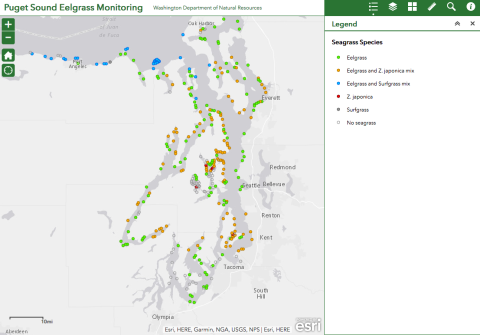
An interactive map created by the Washington Department of Natural Resources provides access to eelgrass monitoring data collected between 2000 and 2015 at selected sites in Puget Sound. 

Scientists want to know why eelgrass is on the decline in some areas of Puget Sound and not others. The answer will affect future strategies for protecting one of the ecosystem’s most critical saltwater plants.

A 2017 report from the Puget Sound Ecosystem Monitoring Program presents an overview of selected recent monitoring and research activities focused on toxic contaminants in the Salish Sea. 

The Puget Sound Ecosystem Monitoring Program (PSEMP) is an independent program established by state and federal statute to monitor environmental conditions in Puget Sound. 

Vessel traffic is increasing in the Puget Sound region. A 2017 article in the journal Aquatic Mammals looks at the potential impacts that increasing vessel disturbance may have on resident harbor seal populations and how future management decisions may need to look at variable buffer zones related to level of human activity.