

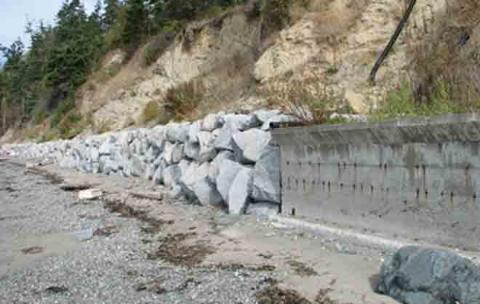
The nearshore habitat of Puget Sound is usually defined as the area from the bluffs that line the shore to the area where water becomes too deep for light to penetrate and allow plants to grow, measured relative to mean lower low water (MLLW). It includes marine habitat and estuarine habitat, but stops at the farthest reach of the tide into an estuary, or the point where saltwater no longer mixes with fresh. Within Puget Sound’s nearshore are many varied habitat types, including rocky and sandy beaches, mudflats, salt marshes, kelp and eelgrass beds, and lagoons.
Sources:
Puget Sound Nearshore Ecosystem Restoration Project: http://www.pugetsoundnearshore.org/technical_reports.html.
Overview
The Puget Sound Nearshore Ecosystem Restoration Project (PSNERP) works to assess the health of Puget Sound nearshore environments and provides strategies for their protection and restoration.



![Bay Mussels (Mytilus trossulus) on Edmonds Ferry Dock. Photo [cropped]: brewbooks (CC BY-SA 2.0) https://www.flickr.com/photos/brewbooks/8840874065](/sites/default/files/styles/large/public/topical_article/images/8840874065_da3b29ce56_crop_1200.jpg?itok=Skf5oEDw "Bay Mussels (Mytilus trossulus) on Edmonds Ferry Dock. Photo [cropped]: brewbooks (CC BY-SA 2.0) https://www.flickr.com/photos/brewbooks/8840874065")