Nearshore habitat

The nearshore habitat of Puget Sound is usually defined as the area from the bluffs that line the shore to the area where water becomes too deep for light to penetrate and allow plants to grow, measured relative to mean lower low water (MLLW). It includes marine habitat and estuarine habitat, but stops at the farthest reach of the tide into an estuary, or the point where saltwater no longer mixes with fresh. Within Puget Sound’s nearshore are many varied habitat types, including rocky and sandy beaches, mudflats, salt marshes, kelp and eelgrass beds, and lagoons.

Sources:

Puget Sound Nearshore Ecosystem Restoration Project: http://www.pugetsoundnearshore.org/technical_reports.html.

Overview

The Puget Sound Nearshore Ecosystem Restoration Project (PSNERP) works to assess the health of Puget Sound nearshore environments and provides strategies for their protection and restoration. 

PSNERP logo

Related Articles

The Washington Invasive Species Council evaluated more than 700 invasive species in and around Washington, considering their threats to the state’s environment, economy, and human health. They included terrestrial plants and animals, aquatic plants and animals (both freshwater and saltwater), insects and diseases. In the end, the council listed 50 “priority species” for action, including five marine animals and two marine plants, along with one virus that infects fish. 

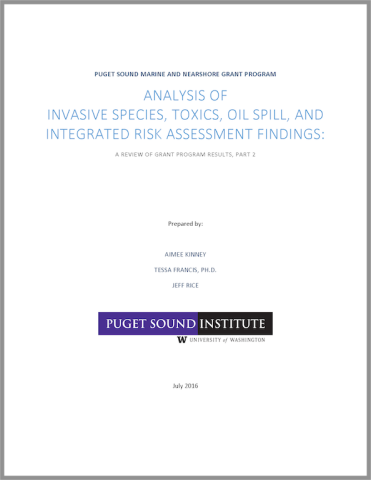
A July 2016 report from the University of Washington Puget Sound Institute summarizes and reviews 10 EPA-funded projects focusing on Puget Sound's marine and nearshore environments. The projects were conducted between 2011-2015 with support from the EPA's National Estuary Program.  The report is an analysis of findings on invasive species, toxics, oil spill, and integrated risk assessment.

Formerly known as “Red Tide”, harmful algal blooms are a health concern for both wildlife and humans. The following is a brief review of some of these algae and their effects.

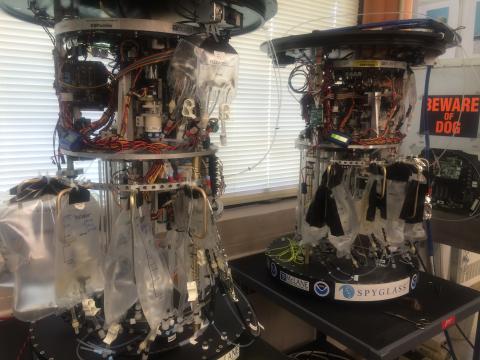
Environmental samplers may provide early detection of harmful algal blooms (HABs) in Puget Sound. This toxic algae is expected to increase as the climate changes, bringing with it new and potentially more severe outbreaks of shellfish poisonings. 

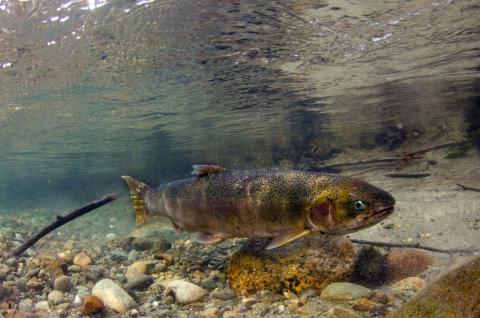
New, smaller acoustic tags will allow scientists to track steelhead migrations in Puget Sound in ways that were once impossible. Will they provide answers to the mysterious decline of these now-threatened fish? 

The Salish Sea Marine Survival Project has mobilized dozens of organizations in the U.S. and Canada to find an answer to one of the region's greatest mysteries. What is killing so many young salmon before they can return home to spawn? A series of talks at the 2016 Salish Sea Ecosystem Conference brought together some of the latest research.