Terrestrial habitat

Terrestrial habitat in Puget Sound varies greatly, from alpine and subalpine meadows and evergreen forests to valleys, floodplains, and prairie. However, these ecosystems are not clearly divided but blend smoothly into each other, linked by rivers and streams and the overlapping ranges of various species, determined by their tolerance of various environmental conditions. Various approaches exist for categorizing habitat types. Franklin and Dyrness developed a system in 1973 using dominant tree species as distinguishing features. In the Northwest, Sitka spruce dominates the lower elevations, moving towards Western hemlock and Douglas fir farther from sea level. Silver fir is more prevalent in the middle range, and mountain hemlock at higher elevations. Jones (1936) established the four Merriam’s Life Zones: Humid Transition, Canadian, Hudson, and Arctic-Alpine, which are defined by vegetation patterns, precipitation, and elevation.

Sources:

Kruckeberg, Arthur. A Natural History of Puget Sound Country.1991. University of Washington Press, Seattle, WA.

Overview

Freshwater habitat in the Puget Sound region consists of rivers, marshes, streams, lakes and ponds that do not have any saltwater input. Many species depend on these freshwater resources, including salmon, salamanders, frogs, and beavers.

Freshwater habitat in King County. Photo by Jeff Rice. All rights reserved.

Related Articles

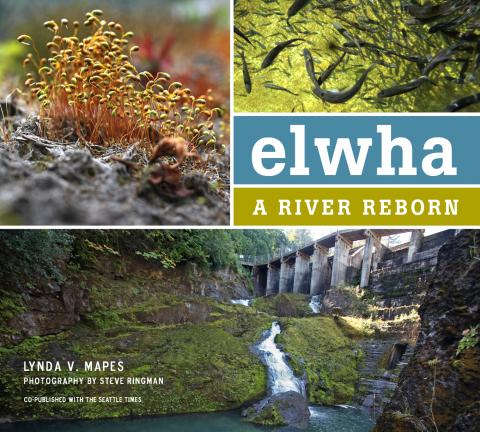
The Encyclopedia of Puget Sound spoke with Seattle Times reporter Lynda Mapes about the exhibit Elwha: A River Reborn, which opened at the University of Washington Burke Museum on November 23rd. The exhibit is based on the book of the same title by Mapes and photographer Steve Ringman, and tells the story of the largest dam removal in U.S. history.  

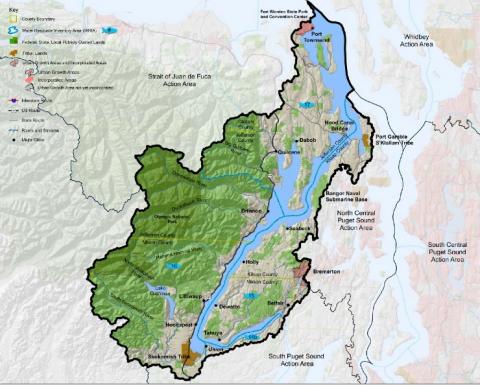
The University of Washington Puget Sound Institute and Stanford University in collaboration with the Hood Canal Coordinating Council report on efforts to select human wellbeing indicators relevant to natural resource management in the Hood Canal watershed.

This page includes documents and links related to the status of Steller Sea Lion in Washington state and the Salish Sea region. 

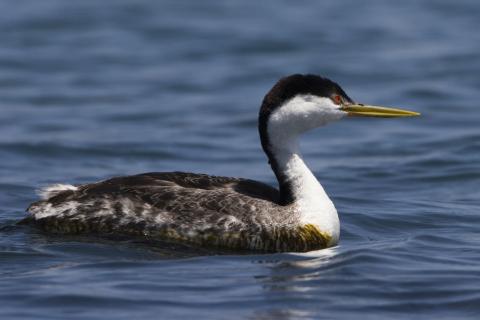
A June 19, 2013 paper in the journal PLoS ONE hypothesizes that regional declines in Western Grebe populations may be related to decreasing numbers of forage fish. Using citizen science data from 36 years of bird counts, researchers were able to look at population trends up and down the entire West Coast, finding that abundance of grebes decreased in the Salish Sea but increased in southern California. North American population declined by 52% overall.

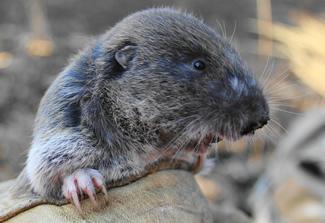
Audio recordings of the Mazama Pocket Gopher.

A paper in the May 2013 issue of The Condor [115(2):356–365, 2013] describes a repeatable and statistically robust approach to monitoring burrow nesting seabirds in the Salish Sea and the California Current that can be applied at single- or multi-island scales. The approach can be applied to both relatively common and important members of the seabird community like the Rhinoceros Auklet and to species of conservation concern like the Tufted Puffin.

The authors provide an approach for simultaneously gathering and identifying habitat information that influences burrow density. This habitat information can in turn be used to inform restoration activities or