Terrestrial habitat

Terrestrial habitat in Puget Sound varies greatly, from alpine and subalpine meadows and evergreen forests to valleys, floodplains, and prairie. However, these ecosystems are not clearly divided but blend smoothly into each other, linked by rivers and streams and the overlapping ranges of various species, determined by their tolerance of various environmental conditions. Various approaches exist for categorizing habitat types. Franklin and Dyrness developed a system in 1973 using dominant tree species as distinguishing features. In the Northwest, Sitka spruce dominates the lower elevations, moving towards Western hemlock and Douglas fir farther from sea level. Silver fir is more prevalent in the middle range, and mountain hemlock at higher elevations. Jones (1936) established the four Merriam’s Life Zones: Humid Transition, Canadian, Hudson, and Arctic-Alpine, which are defined by vegetation patterns, precipitation, and elevation.

Sources:

Kruckeberg, Arthur. A Natural History of Puget Sound Country.1991. University of Washington Press, Seattle, WA.

Overview

Freshwater habitat in the Puget Sound region consists of rivers, marshes, streams, lakes and ponds that do not have any saltwater input. Many species depend on these freshwater resources, including salmon, salamanders, frogs, and beavers.

Freshwater habitat in King County. Photo by Jeff Rice. All rights reserved.

Related Articles

A December 2014 paper in the journal Aquatic Ecosystem Health & Management describes a project to identify transboundary ecosystem indicators for the Salish Sea. 

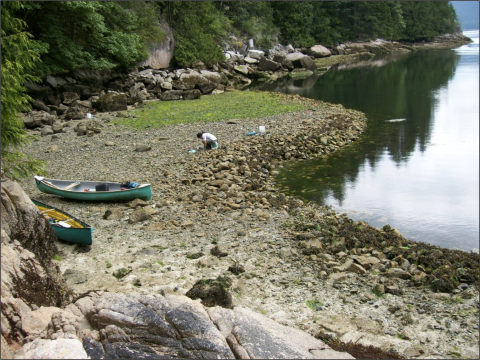
Northwest Coast First Peoples made clam garden terraces to expand ideal clam habitat at tidal heights that provided optimal conditions for clam growth and survival, therefore enhancing food production and increasing food security.

Scientists are rethinking floodplain management in Puget Sound. Can we have our farms and salmon too?

A 2014 report explains the development of a comprehensive land use plan that is based on the ecological values and functions of the Gorst Creek Watershed in southeast Kitsap County.

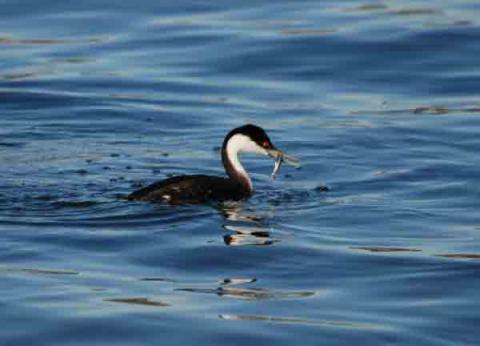
Birds that dive for fish while wintering in the Salish Sea are more likely to be in decline than nondiving birds with less specialized diets, according to a 2014 study led by the School of Veterinary Medicine at the University of California, Davis. The study, published in the journal Conservation Biology proposes that long-term changes in the availability of forage fish are pushing the declines.

Why did all the grebes leave? Where did they go? And what does their disappearance say about the health of the Salish Sea? Seasonal declines among some regional bird species could hold important clues to the overall health of the ecosystem.