Terrestrial habitat

Terrestrial habitat in Puget Sound varies greatly, from alpine and subalpine meadows and evergreen forests to valleys, floodplains, and prairie. However, these ecosystems are not clearly divided but blend smoothly into each other, linked by rivers and streams and the overlapping ranges of various species, determined by their tolerance of various environmental conditions. Various approaches exist for categorizing habitat types. Franklin and Dyrness developed a system in 1973 using dominant tree species as distinguishing features. In the Northwest, Sitka spruce dominates the lower elevations, moving towards Western hemlock and Douglas fir farther from sea level. Silver fir is more prevalent in the middle range, and mountain hemlock at higher elevations. Jones (1936) established the four Merriam’s Life Zones: Humid Transition, Canadian, Hudson, and Arctic-Alpine, which are defined by vegetation patterns, precipitation, and elevation.

Sources:

Kruckeberg, Arthur. A Natural History of Puget Sound Country.1991. University of Washington Press, Seattle, WA.

Overview

Freshwater habitat in the Puget Sound region consists of rivers, marshes, streams, lakes and ponds that do not have any saltwater input. Many species depend on these freshwater resources, including salmon, salamanders, frogs, and beavers.

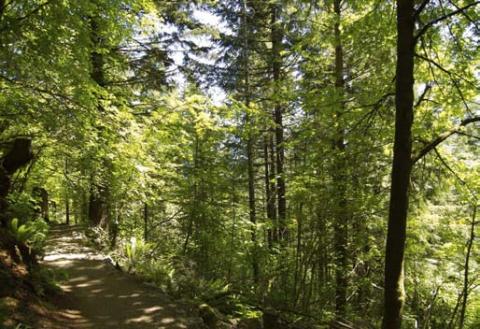
Freshwater habitat in King County. Photo by Jeff Rice. All rights reserved.

Related Articles

The history of land use in King County has produced a lowland and foothill landscape of bewildering variety. The once continuous forest of western hemlock, Douglas-fir, and redcedar has given way to a patchwork of lawns, parks, playgrounds, woodlots, greenbelts, old fields, croplands, tree farms, and remnant forests set amid a landscape of urban, suburban, rural, and commercial uses, all joined and, at the same time, separated by a vast network of roads and communication corridors. Despite this apparent richness and variety of patches, this landscape is clearly human-dominated, and habitats for native species have generally been marginalized by the

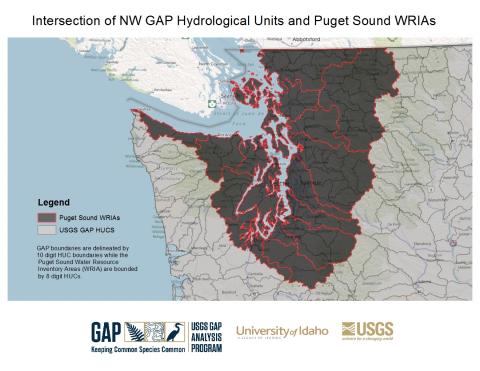
The Encyclopedia of Puget Sound, in cooperation with the USGS, has developed a list of terrestrial vertebrates occurring within the Puget Sound basin.

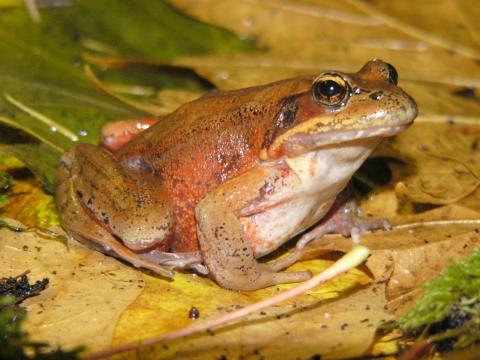
The Northern Red-legged Frog is described here relative to its local behavior, habitat, threats and morphology.

A botanist believes Coast Salish tribes once favored small islands in the San Juan archipelago for growing camas, an important food staple. Her studies may also show the vulnerability of these relic gardens to climate change as sea levels rise.

"Habitat" describes the physical and biological conditions that support a species or species assemblage and refers to conditions that exist at many scales. An oyster shell provides habitat for some algae and invertebrates, whereas cubic miles of sunlit water in Puget Sound comprise the habitat for many planktonic species.

Non-native species are those that do not naturally occur in an ecosystem. A non-native species is considered invasive when it is capable of aggressively establishing itself and causing environmental damage to an ecosystem. Plants, animals, and pathogens all can be invasive.