Terrestrial habitat

Terrestrial habitat in Puget Sound varies greatly, from alpine and subalpine meadows and evergreen forests to valleys, floodplains, and prairie. However, these ecosystems are not clearly divided but blend smoothly into each other, linked by rivers and streams and the overlapping ranges of various species, determined by their tolerance of various environmental conditions. Various approaches exist for categorizing habitat types. Franklin and Dyrness developed a system in 1973 using dominant tree species as distinguishing features. In the Northwest, Sitka spruce dominates the lower elevations, moving towards Western hemlock and Douglas fir farther from sea level. Silver fir is more prevalent in the middle range, and mountain hemlock at higher elevations. Jones (1936) established the four Merriam’s Life Zones: Humid Transition, Canadian, Hudson, and Arctic-Alpine, which are defined by vegetation patterns, precipitation, and elevation.

Sources:

Kruckeberg, Arthur. A Natural History of Puget Sound Country.1991. University of Washington Press, Seattle, WA.

Overview

Freshwater habitat in the Puget Sound region consists of rivers, marshes, streams, lakes and ponds that do not have any saltwater input. Many species depend on these freshwater resources, including salmon, salamanders, frogs, and beavers.

Freshwater habitat in King County. Photo by Jeff Rice. All rights reserved.

Related Articles

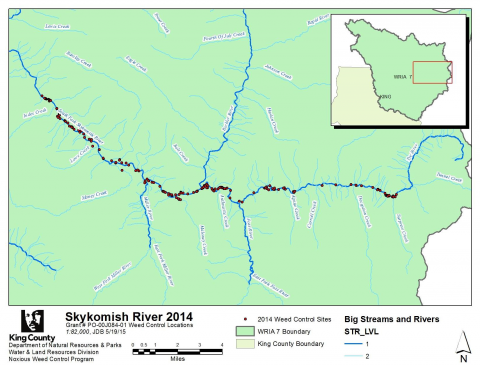
The final report on a knotweed removal and native plant project from grant PO-00J08401 to King County DNR for the grant entitled: Protection and enhancement of the riparian buffers in WRIA 7 through restoration and stewardship.

This report, Priority science for restoring and protecting Puget Sound: a Biennial Science Work Plan for 2011-2013, identifies priority science and monitoring questions needed to coordinate and implement effective recovery and protection strategies for Puget Sound.

Sound Science: Synthesizing Ecological and Socio-economic Information about the Puget Sound Ecosystem summarizes what we know about the greater Puget Sound ecosystem and what we think could happen in the future given present trajectories and trends.

The 2011 Salish Sea Ecosystem Conference was held October 25 to 27 at the Sheraton Wall Centre in Vancouver, British Columbia. This event brought together a diverse group of government officials, community leaders, First Nations and tribal members, environmental managers, scientists and academics to learn from each other about the state and threats to the shared ecosystem. Over 950 delegates attended.

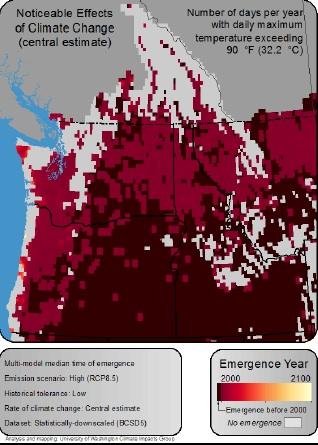
A December 2014 report from the University of Washington examines when and where climate change impacts will occur in the Puget Sound watershed.

When and where will we see the impacts of climate change in Puget Sound? A web-based tool factors in dozens of site-specific variables for watersheds throughout the Pacific Northwest. The resource was developed by the University of Washington Climate Impacts Group with support from the EPA, the US Army Corps of Engineers and the Center for Data Science, University of Washington-Tacoma.