

All Articles
2014 Salish Sea Ecosystem Conference
The 2014 Salish Sea Ecosystem Conference took place April 30-May 2 at the Washington State Convention Center in downtown Seattle. Over 1200 delegates attended the conference.
Puget Sound's Health 2002
This is the Puget Sound Water Quality Action Team's third report on key indicators of Puget Sound's Health. We prepared the report in response to the Washington State Legislature's request to evaluate efforts to protect Puget Sound. The report includes updated information on the 17 indicators presented in 2000 as well as information on two new indicators.
2011 Salish Sea Ecosystem Conference
The 2011 Salish Sea Ecosystem Conference was held October 25 to 27 at the Sheraton Wall Centre in Vancouver, British Columbia. This event brought together a diverse group of government officials, community leaders, First Nations and tribal members, environmental managers, scientists and academics to learn from each other about the state and threats to the shared ecosystem. Over 950 delegates
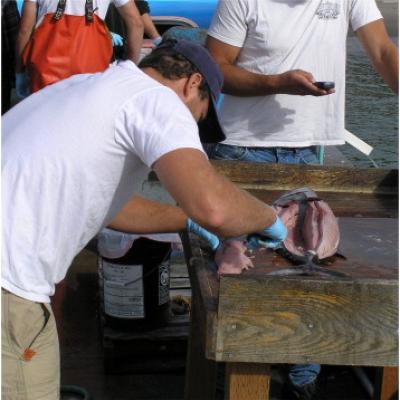
Subsistence fishing in a 21st century capitalist society: From commodity to gift
A 2015 paper in the journal Ecological Economics evaluated “personal use” and subsistence use of seafood among commercial operators in Washington and California, as well as the extent, range, and species diversity of noncommercial wild ocean seafood subsistence harvests.
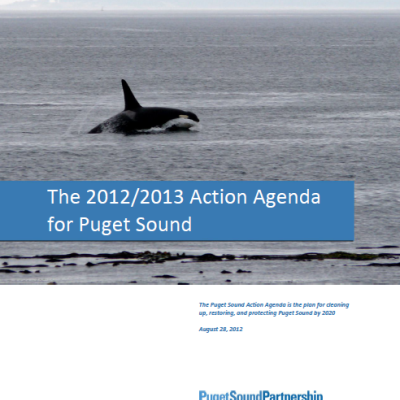
The 2012/2013 Action Agenda for Puget Sound
The Puget Sound Action Agenda lays out the work needed to protect and restore Puget Sound into the future. It is intended to drive investment and action. The 2012 Action Agenda is the result of over a year of work with state and federal agencies, tribal governments, local governments, representatives of the business and environmental caucuses, and other interested partners. It builds on the first

1988-2009 Puget Sound Georgia Basin conferences proceedings
The 1988-2009 conferences Puget Sound Research and Puget Sound Georgia Basin are the predecessors of the Salish Sea Ecosystem Conference.
1988 Committee on Research in Puget Sound
This report presents the findings and recommendations of the Committee. The recommendations will be presented for comment and discussion by participants at the First Annual Meeting on Puget Sound Research, which will be convened in Seattle on March 18 and 19, 1988.
Monitoring for adaptive management: status and trends of aquatic and riparian habitats in the Lake Washington/Cedar/Sammamish watershed (WRIA 8)
King County conducted physical and biological monitoring between 2010 and 2013 in the Lake Washington/Cedar/Sammamish (WRIA 8) watershed using common survey protocols and a probabilistic survey design. Hydrologic monitoring was also conducted at several locations to supplement physical and biological monitoring.
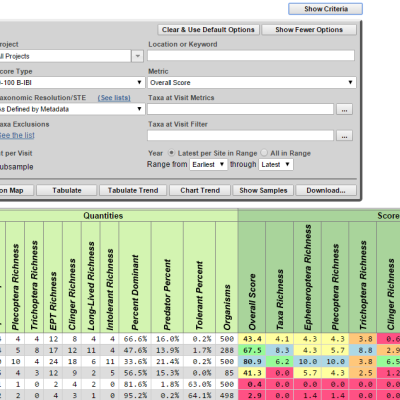
Enhancement and standardization of benthic macroinvertebrate monitoring and analysis tools for the Puget Sound region
With funding from an EPA grant from 2010-2014, King County worked with regional partners and experts to enhance data analysis tools and encourage collaboration and standardization for benthic macroinvertebrate monitoring in the Puget Sound region.
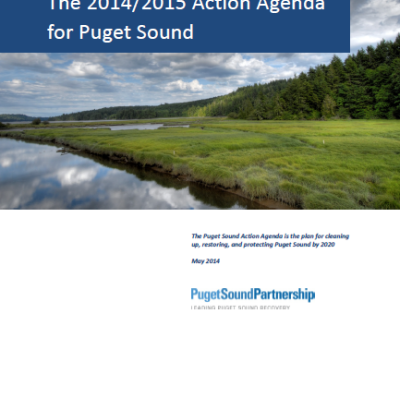
The 2014/2015 Action Agenda for Puget Sound
The Puget Sound Actiona Agenda is a shared plan for Puget Sound recovery resulting from a collaboration by state and federal agencies, tribal governments, local governments, business and environmental groups, and others.