Terrestrial habitat

Terrestrial habitat in Puget Sound varies greatly, from alpine and subalpine meadows and evergreen forests to valleys, floodplains, and prairie. However, these ecosystems are not clearly divided but blend smoothly into each other, linked by rivers and streams and the overlapping ranges of various species, determined by their tolerance of various environmental conditions. Various approaches exist for categorizing habitat types. Franklin and Dyrness developed a system in 1973 using dominant tree species as distinguishing features. In the Northwest, Sitka spruce dominates the lower elevations, moving towards Western hemlock and Douglas fir farther from sea level. Silver fir is more prevalent in the middle range, and mountain hemlock at higher elevations. Jones (1936) established the four Merriam’s Life Zones: Humid Transition, Canadian, Hudson, and Arctic-Alpine, which are defined by vegetation patterns, precipitation, and elevation.

Sources:

Kruckeberg, Arthur. A Natural History of Puget Sound Country.1991. University of Washington Press, Seattle, WA.

Overview

Freshwater habitat in the Puget Sound region consists of rivers, marshes, streams, lakes and ponds that do not have any saltwater input. Many species depend on these freshwater resources, including salmon, salamanders, frogs, and beavers.

Freshwater habitat in King County. Photo by Jeff Rice. All rights reserved.

Related Articles

Many creeks and waterbodies in Puget Sound may look pristine, but most face serious threats from stormwater pollution. A new study at Soos Creek shows how mud-dwelling bugs, traditional chemistry and digital "heatmaps" can be used to track stormwater impacts and identify the most polluted areas. Scientists and planners hope that this may one day lower the price tag on costly stormwater fixes. 

Historically, the eastern part of the state has seen the largest impacts from fires, but climate change is now increasing the risk west of the Cascades. That could have big implications for many rural communities throughout Western Washington, including those in the Puget Sound region.

Climate models project that if carbon emmisions continue as they are now, the vast majority of watersheds feeding Puget Sound will receive more rain and far less snow by 2080, causing increased flooding and other dramatic changes to the freshwater ecosystem. We look at the past and possible future of the region's snowpack and what this might mean for salmon and other species — including humans.

Freshwater habitat in the Puget Sound region consists of rivers, marshes, streams, lakes and ponds that do not have any saltwater input. Many species depend on these freshwater resources, including salmon, salamanders, frogs, and beavers.

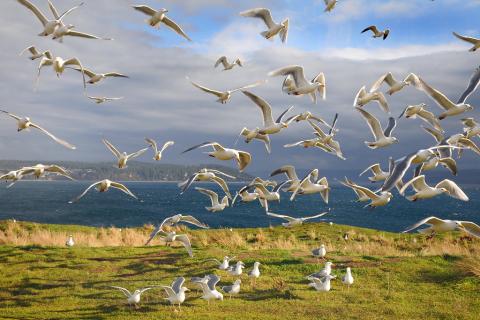
An unintended consequence of the recovery of bald eagles (Haliaeetus leucocephalus) has been the impact on seabirds. The authors of a 2019 paper published in Ecology and Evolution suggest that the effects of bald eagle activity on a large glaucous-winged gull (Larus glaucescens) colony on Protection Island in the Strait of Juan de Fuca include the possibility of coexistence but also the possibility of gull colony extinction.

Can scientists bring back the lost tidal forests of Puget Sound? It could take generations, but restoring this rare habitat will pay big dividends for Puget Sound’s salmon.